by CA Russell
Listen. Nobody told us they were going to be like this.
Nobody told us the dead would rise and immediately, with the specific purposefulness of men who have already wasted enough time in line at ANSES, walk to the nearest open field and start marking out a pitch.
That’s what happened. That’s the whole story, except it isn’t, because nothing that happens in this city is ever the whole story, and because Rubén from the building on Avenida Directorio — a man who had, in life, a genuinely impressive capacity for stating the obvious — died on a Thursday and by Saturday morning was out on the potrero behind the old Metrogas plant, arguing with a decomposing gentleman in a Boca jersey about whether the left touchline was three meters too narrow.
He was right, incidentally. It was four meters too narrow.
We had expected appetite. We had been led to believe, by a century of cinema and the general pattern of human experience, that the dead come back hungry. Ravenous. That the first thing a reanimated corpse wants is to press its ruined face against the living and consume what it no longer has.
Nobody told us that what Rubén no longer had, primarily, was a Sunday league team, because three of the regulars had moved to Quilmes and the goalkeeper had stopped picking up calls.
The dead came back and they were not hungry. They were available.
They had, for the first time in years, nothing else to do.
The apocalypse, when it began, was orderly in the way that catastrophes in Buenos Aires tend to be orderly: chaotically, and with a great deal of paperwork generated after the fact to explain why no one was responsible for it.
The Emergency Committee convened in the basement of the Ministry of Health on a Tuesday. They had seventeen items on the agenda. Items one through sixteen concerned the procurement of ventilators, the status of cold storage contracts, and a pending resolution from the Colegio Médico regarding whether the undead retained the right to social security benefits.
Item seventeen was: Football.
“It has been brought to our attention,” said the undersecretary, a small man named Alderete who had perfected the art of communicating alarm without technically expressing it, “that the affected population has organized itself into several competitive structures. We have confirmed leagues operating in Flores, Villa del Parque, Lugano, and what appears to be a regional tournament in Lomas de Zamora.”
Silence.
“Are they dangerous?” someone asked.
“Not to us,” said Alderete. “To each other, occasionally. There was an incident in the semifinal that we are still assessing.”
More silence.
“Are they good?” asked the Secretary of Sports, who had wandered into the wrong meeting but decided to stay.
Alderete looked at his papers. “Technically, yes. They don’t tire. They don’t cramp. They are impervious to weather conditions and psychological pressure. The offside trap, however, presents conceptual difficulties, and the referee situation is—” He paused. “Complex.”
The referee situation was this: the dead would not accept the authority of the living over calls made in the final third.
This was, the sociologists noted later, not unprecedented behavior.
I went to watch them play because Rubén had been my neighbor for eleven years and I owed him two hundred pesos from a bet about the 2019 Superliga that I had never paid, and it seemed important, in the circumstances, to account for my debts. I don’t know why. Proximity to the end of the world makes you superstitious about small things.
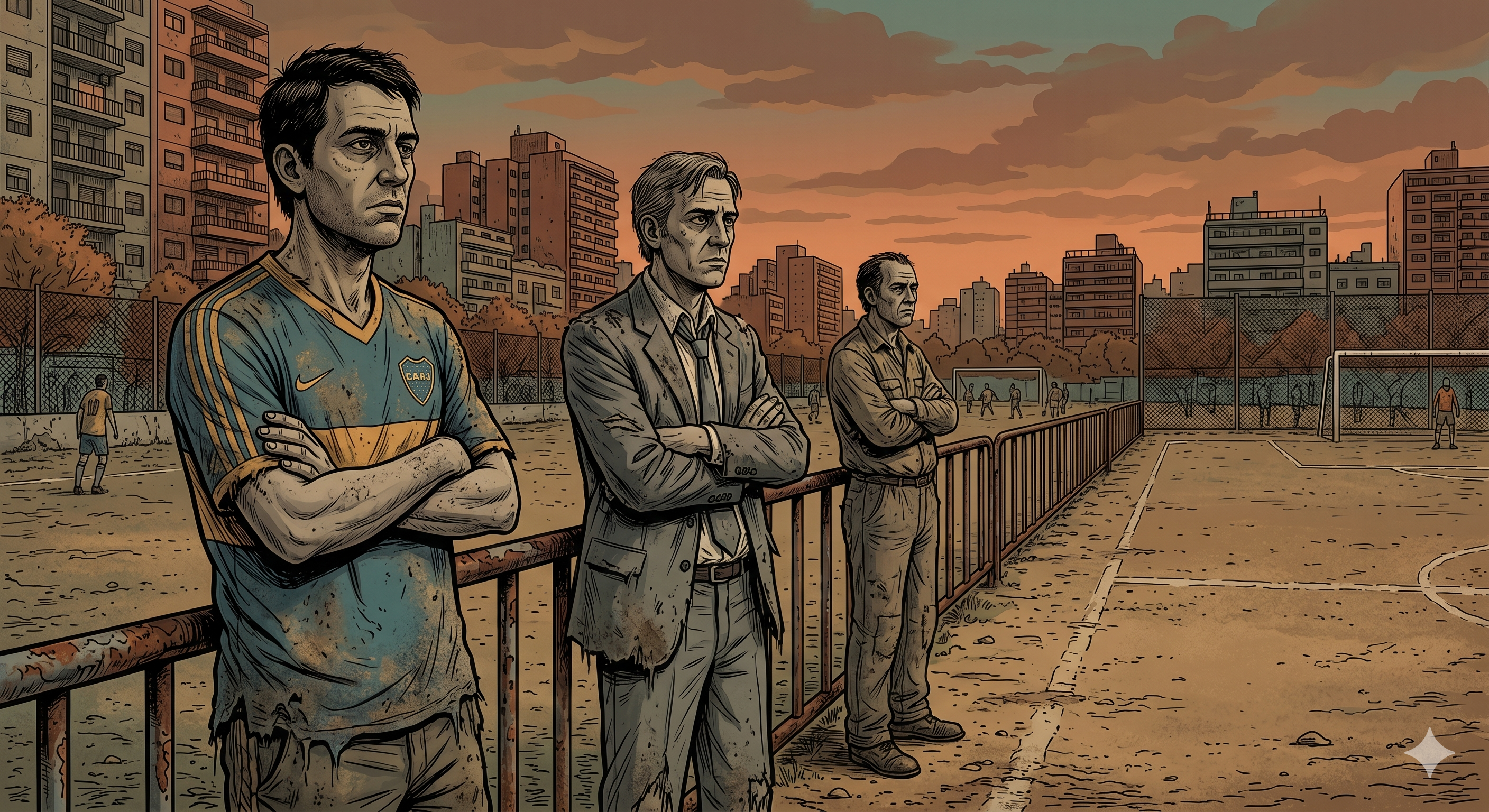
The field behind the Metrogas plant had been cleared and leveled. The goals were made from water pipes and welded with a competence that Rubén, who had been a plumber, had never exhibited while alive. Around the perimeter, the dead stood watching in the particular posture of Argentine men watching football: arms crossed, weight on one hip, expression suggesting that what they are witnessing confirms everything they already knew.
They played barefoot, most of them. Some still wore the clothes they had died in. One man, who had apparently suffered a cardiac arrest at some formal occasion, played in a grey suit that had been through considerable deterioration. He was the best player on the field. He had a left foot that moved like water finding a gap in stone.
I stood at the edge and watched for forty minutes and did not think once about the end of the world.
That seemed important too.
The first organized match between the living and the dead took place in Parque Chacabuco on a Sunday in early autumn, because of course it did, because in this city the living and the dead have always eventually ended up sharing the same parks.
It had been negotiated over three weeks by a committee that included two members of the Football Association, a municipal official, the president of the neighborhood association of Villa Soldati, and a man named Héctor who was not officially representing anyone but who was there every day and whose sandwiches kept the meetings going.
The conditions were as follows: no biting (unanimously agreed upon). No deliberate dismemberment during set pieces (passed seven to two, with two abstentions who felt this was already covered by existing FIFA regulations). Standard ninety-minute match, with the acknowledgment that several players from the undead squad were not in a condition to observe the half-time whistle, which was noted in the minutes as a known logistical challenge.
The dead won 4-1.
The living disputed none of the goals.
The third goal, from a corner, involved a header that required a degree of physical indifference to pain that, once you have seen it, you cannot unfeel.
After the match, Rubén found me by the railing. He looked at me for a long time in the way he had always looked at things — with the expression of a man who has something to say but is calculating whether saying it is worth the energy.
“You still owe me two hundred pesos,” he said.
His voice was different. Slower. Like a cassette tape played at the wrong speed. But the complaint was perfectly preserved. Some things survive everything.
“I know,” I said.
He nodded. Seemed satisfied. Turned back toward the field where his teammates were conducting a post-match analysis with the quiet intensity of men who had nowhere else to be, and no longer any reason to hurry.
That was six months ago.
The leagues are structured now. There is a table. There is a website maintained, nobody knows how, by an entity in San Justo who handles the statistics with a precision that living sports journalists have openly described as humiliating. The dead have their own chants. They are slower than living chants, more deliberate, tidal in their rhythm, and they carry across the city at night when everything else is quiet, and you lie in your apartment on Rivadavia and listen to them and feel something you cannot name pressing against the inside of your chest.
It is not fear, exactly.
It is more like the feeling you get when someone plays a piece of music you had forgotten you knew, and your body remembers it before your mind does.
There is a word for what happened to us. I have been looking for it for six months and I think, finally, I have found it.
Relief.
The dead came back and they did not want us. They wanted the ball. They wanted the ninety minutes and the argument and the specific anguish of the woodwork and the long walk home after a draw when everything you did was almost enough but almost is a word that has no mercy in any language.
They came back for the one thing that had made them feel, while they were living, that being alive was worth the administrative inconvenience of it.
Who are we to say they were wrong.
The two hundred pesos. I know, I know.
I left an envelope with Rubén’s granddaughter, who is twelve and who takes the whole situation with the philosophical calm of someone who has not yet lived long enough to know that this should be impossible.
“He says to tell you,” she said, “that it doesn’t count the same if you pay after he died.”
“He’s not wrong,” I said.
“He says also that if you want to watch the match on Sunday, they’re playing Racing. He says you can sit in the good section.”
I thought about that for a moment.
“Which is the good section?”
She pointed to a spot along the south railing, where three men in various states of postmortem deterioration stood with their arms crossed in the classic posture, watching the field where nothing was happening yet, waiting with the absolute patience of those who have already outlasted their own endings.
I went on Sunday.
I am going again this week.
The table doesn’t lie: they are five points clear at the top, and the season is not yet halfway done.
My Other Car is a Robot — myothercarisarobot.com


 My Other Car is a Robot
Leave a comment