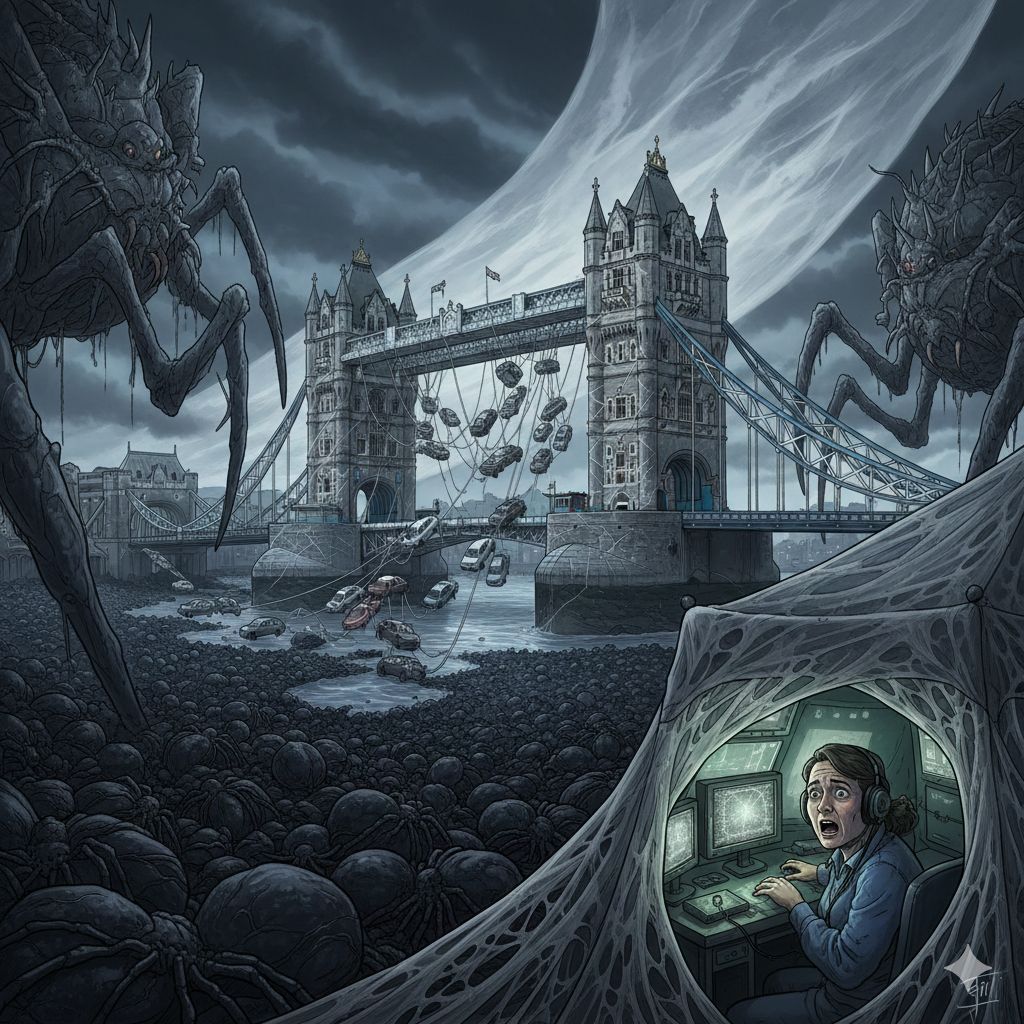
The first thing you need to understand is that they didn’t evolve. Evolution is a slow, stumbling process of trial and error, a blind climb up a genetic ladder. This wasn’t that.
They decided.
Dr. Sarah Venkman would later testify—before the Subcommittee on Interspecies Aggression, before the cameras, before a God who had clearly checked out for the weekend—that the pheromone shift occurred simultaneously across seventeen different species on four continents within a six-hour window. Statistically, it was a glitch in the universe. It was as if every spider on Earth woke up one Tuesday morning and found a new set of operating instructions written into their very atoms.
But they did.
Marcus Webb saw it happen in his basement in Spokane. He was sorting darks from lights, a mundane ritual of a species that thought it owned the dirt, when he noticed them gathering. Not just the common house spiders, but the jumpers, the wolf spiders, the cellar dwellers. They were pouring from the ceiling joists and the floor drains in a silent, glistening tide.
He screamed and dropped his laundry. The spiders didn’t scatter. They didn’t exhibit the frantic, jerky flight of a panicked insect.
They waited.
”They’re looking at me,” he told the 911 operator, his voice thin with the realization that the rules of the world had just been deleted. “They aren’t biting. They’re just… measuring.”
The operator told him to leave the basement. Standard protocol. Marcus never made it to the stairs. The spiders didn’t need to be fast; they just needed to be everywhere. They didn’t bite him. They simply occupied the space where he needed to stand, a living carpet that rippled like muscle, until he tripped. Then they became a blanket. He didn’t die of venom. He died of weight—the collective mass of ten thousand tiny heartbeats pressing the air out of his lungs.
The thing about spiders—the detail that kept Dr. Venkman awake for seventy-three hours before the military forcibly sedated her—is that the math had always been there, hiding in plain sight. The global spider population weighs approximately 25 million tons. Humans? About 350 million. But spiders eat roughly 400 to 800 million tons of prey annually.
A scientist in Basel had published a paper on it in 2017. He’d called it a “quirky thought experiment.” If spiders ever shifted their diet to human biomass, he mused, they could finish us off in twelve months.
The paper won him a minor award and seventeen citations. We treated it like a trivia fact. They treated it like a blueprint.
In Mumbai, the “Decision” arrived during the monsoon. They didn’t crawl through the doors of the Lodha building; they poured through the ventilation systems like black oil. These were people who paid premium prices for “Bio-Filtered Air,” yet they died in their sleep as the vents vomited a silent, multi-legged slurry into their bedrooms.
The building had 487 residents. It took four days to clear it. The screaming only lasted two. By day three, the spiders had learned to jam the fire doors with silk so thick it required a chainsaw to breach. They weren’t just eating; they were warehousing. They treated the luxury high-rise like a silo, and the humans inside like grain.
Meanwhile, fragmented messages documented the world’s unraveling.
[SMS ARCHIVE – SEATTLE, WA]
14:12: Hey, did you see the news? The spiders in the yard are all facing North.
14:45: Hundreds of them. Just sitting there. It’s creepy as hell.
15:30: Mark? They’re inside. I don’t know how. I taped the vents. I taped the door. They’re coming out of the electrical outlets.
15:32: They aren’t biting me, Mark. They’re just… sitting on me. I can’t move my legs. They’re so heavy.
15:35: Help.
Sarah Venkman stood in her lab at MIT, watching the footage from twelve different cities. Her reflection in the monitor looked like a ghost. She’d stopped eating; her body was practicing for the inevitable.
”They’re not communicating,” she whispered to the empty room. Her colleagues had all gone home to barricade themselves behind drywall and deadbolts—pathetic, thin membranes that the spiders could bypass through a keyhole. “Communication implies a sender and a receiver. This is coherence. They’ve become a single, global organism. Eight million billion limbs, one central nervous system.”
On the screens: São Paulo. Moscow. Jakarta. Phoenix.
The military tried. Of course they did. They used flamethrowers in Sydney and nerve gas in Berlin. They dropped a tactical nuke outside Los Angeles when the infestation reached critical mass. But you can’t fight the floor. You can’t declare war on the air. For every million spiders burned, ten million emerged from the cracks in reality itself.
The planet was made of them. We had just been the guests who overstayed our welcome.
[EMERGENCY DISPATCH TRANSCRIPT – LONDON, UK]
OPERATOR: Emergency, which service?
CALLER: (Sound of heavy breathing, high-pitched scratching in the background) They’ve taken the bridge.
OPERATOR: Sir, please stay calm. Is this a protest?
CALLER: No. You don’t understand. The cables. They aren’t steel anymore. They’ve wrapped the bridge in white. It looks like a cocoon. The cars… they’re pulling the cars off the road.
OPERATOR: Who is pulling them off, sir?
CALLER: (A wet, snapping sound) The silk. It’s stronger than the suspension cables. They’re reeling us in. Oh god, it’s not a web. It’s a winch.
[UNSENT EMAIL – NASA AMES RESEARCH CENTER]
FROM: d.holloway@nasa.gov
TO: [REDACTED]
SUBJECT: It’s not just the ground.
We were looking the wrong way. Everyone is staring at the basements and the vents. We just got the last high-res feed from the ISS before the uplink went dark.
It’s visible from orbit, Sarah. A white film. It’s spreading across the Amazon, then the Congo. It’s not just webs. They’re changing the albedo of the planet. They’re reflecting the sun. They aren’t just eating us; they’re terraforming. They’re turning the Earth into a nursery.
I’m looking out the window now. The glass is starting to frost over. But it’s not ice. It’s the same white film.
Sarah’s last video diary was recorded on Day 267.
There was no internet anymore. The grid had flickered out weeks ago after the spiders learned that power lines were the only thing that moved faster than they did. She was recording onto a dying laptop powered by a hand-cranked radio. The lab was dark, save for the blue glow of the screen.
”We named ourselves apex predators,” she said, and her laugh sounded like broken glass in a garbage disposal. “We split atoms. We touched the moon. And the whole time, we were just being tolerated. We were a crop they were waiting to harvest. And we’re finally ripe.”
She looked away from the lens. A soft, susurrant sound filled the room—the whisper of a billion legs negotiating the acoustic ceiling tiles.
”They’re here,” she said, her voice almost relieved. “They’ve finished with the cities. They’re moving into the ‘isolated’ zones now.”
The camera stayed on for another forty-seven seconds. It captured the ceiling tiles bowing downward under a sudden, impossible weight. It captured the moment the white acoustic foam shattered, and the black, heaving tide poured through.
[FINAL AUDIO CLIP – DR. SARAH VENKMAN]
(Sound of static, then the rhythmic ‘thrum’ of millions of vibrating abdomens)
”Day 360. The silence is the loudest thing left. I used to think the ‘Global Weight’ was a metaphor for our collective guilt. I was wrong. It’s literal. I can feel the building settling. Not because of age, but because of the mass. There are four tons of them in the hallway alone.
They’ve stopped eating. They’re waiting for the atmosphere to change. The silk… it’s thickening the air. Trapdoor spiders have begun sealing the subway tunnels. They’re turning the crust of the Earth into a lid.
We were the topsoil. They’re just… putting the planet back in the box.”
(Sound of a chair dragging. A soft, wet rustle. End of recording.)
The last human died on Day 364.
The spiders finished their work one year and one day after they began. Then, they didn’t return to the shadows. They didn’t go back to the corners of the room. They stayed in the streets, in the beds, in the cathedrals.
They are patient. They are eternal. And they are still hungry for whatever the universe decides to send next.

 My Other Car is a Robot
Leave a comment