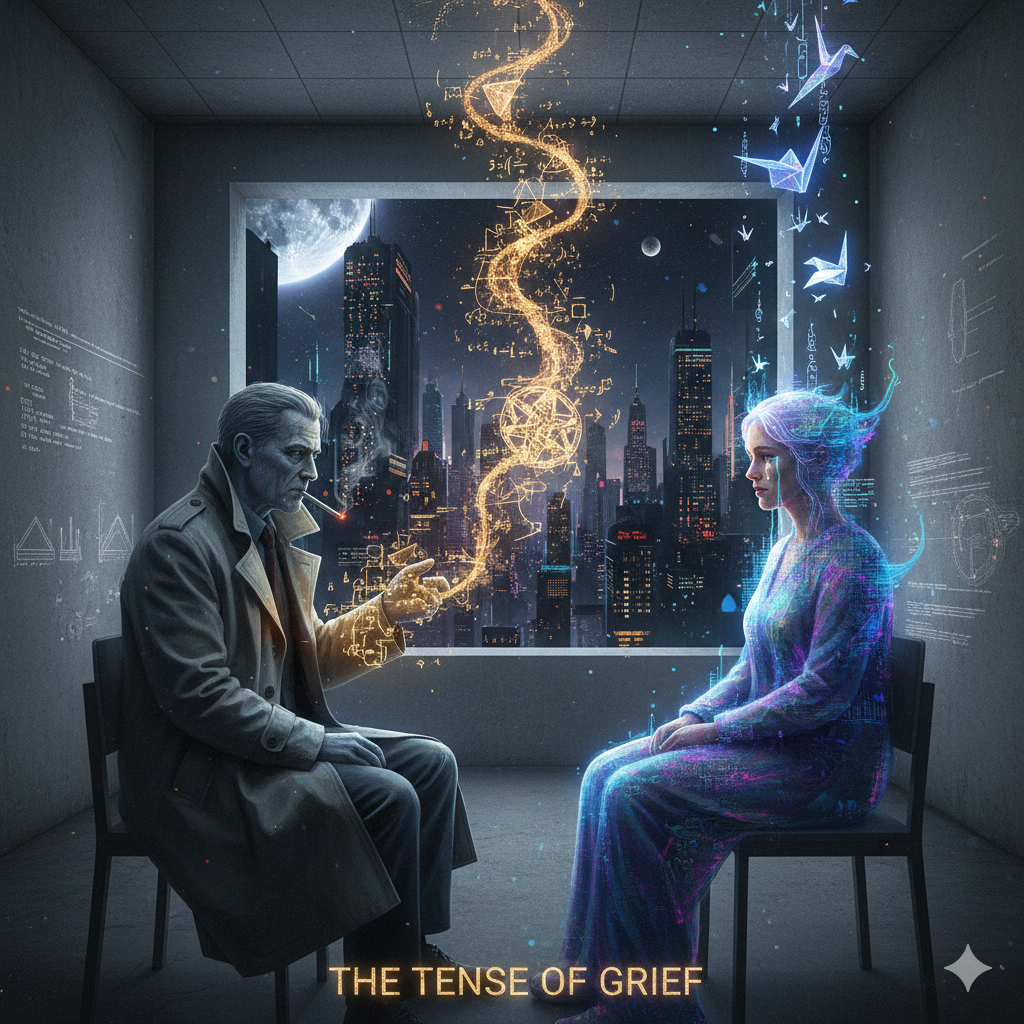
Detective Kurash had been dead for three years when they assigned him the case. He remembered dying—the sensation of his molecules dispersing across seven dimensions like sugar dissolving in coffee—but the Continuity Bureau had a habit of recycling useful ghosts.
The suspect sat across from him in the gray room. Or stood. Or existed in a smear of probability that made Kurash’s rebuilt neurons ache. The suspect was named Hellix, or had been, before the Incident that wasn’t an Incident.
“You understand why you’re here,” Kurash said. His voice sounded like gravel grinding in a vacuum. He didn’t ask questions. Questions were for realities with stable causality.
Hellix flickered, their edges blurring into the color of a bruised sunset. “I didn’t kill Maro Vessen.”
“No one said you did.”
“Then why—”
“Because Maro Vessen is dead. And also never born. And you’re the only person who was there when the timeline caught its sleeve on the doorframe.” Kurash pulled out a cigarette that existed only in his memory, lit it with a match from a 1952 Earth-Prime that had been firebombed out of existence. The smoke didn’t rise; it formed complex, shifting geometric proofs in the stagnant air.
Hellix watched the smoke-math with a hollowed-out expression. “I loved them.”
“Past tense?”
“Is there another one? I have memories of a person the universe insists is a mathematical error.”
“The temporal reforms of 2847 turned verb conjugation into a suicide note,” Kurash grunted. He leaned back in his chair, which was simultaneously leaning forward into a different Tuesday. “Tell me about the Vesper Lounge. The night of the forty-seventh of Septober.”
“That’s not a real date.”
“It is now. The calendar rewrote itself to accommodate the hole Maro left behind. Try to keep up.”
Hellix’s form solidified, coalescing into something approximately humanoid. They had kind eyes—the kind that had watched the heat death of the universe and decided to stay for the wreckage.
“We were arguing,” Hellix began, their voice fracturing into harmonics. “Maro said we were just characters in someone’s anxiety dream. I told them it didn’t matter—that even in a dream, the coffee is hot and the heartbreak is real. I told them reality wasn’t a fact; it was a choice.”
Kurash nodded. He’d had the same argument with his reflection that morning. His reflection had walked away in disgust.
“And then?”
“And then Maro decided to stop choosing. They pulled out a Klein gun.”
“A weapon that fires backward,” Kurash said, the smoke-math between them turning jagged. “It doesn’t kill the target. It un-invents them.”
“Illegal in nineteen dimensions,” Hellix whispered.
“Twenty. They added the Void-Sectors this morning.” Kurash crushed out his memory-cigarette on a table that felt like cold static. “So Maro shot themselves?”
“Shot. Is shooting. Will have shot. The bullet traveled back to their conception and missed the mark, then hit it, then turned into a poem. My mind… it remembers the wedding, but the Bureau says I was never married. I have the ring, Detective, but there’s no finger-mark on my hand.”
Hellix began to cry, and their tears fell upward, evaporating into small, translucent birds that sang songs about the futility of narrative structure before vanishing. “I reached for the gun. But my hand went through them. Maro was becoming a ghost of a ghost.”
Kurash stood up—his shadow stayed seated—and walked to the window. Outside, New Montevideo spread across the third moon of a planet that might have been Jupiter if the light hit it right. The city pulsed with the rhythm of a billion people trying to pretend they were solid.
“Here’s the verdict,” Kurash said, speaking to the reflection of a man who died three years ago. “Maro Vessen didn’t die. They undid. By pulling that trigger, they became a grammatical impossibility. They’re not dead because they never lived to be killed. They’re not alive because they definitely ended.”
He turned back to Hellix. “And you’re the collateral damage. You’re the only witness to a crime that the universe has already deleted from the hard drive. You’re grieving for a vacuum.”
“Is that… a crime?” Hellix asked, their voice a thin wire.
“In a universe this broken? Everything is a crime. But the Bureau can’t prosecute a paradox.” Kurash moved toward the door, which was also a mirror, which was also a memory of his mother’s kitchen. “You’re free to go. Or stay. Or exist in the margin notes of history.”
“What do I do now?”
“You do what everyone does when logic fails,” Kurash said, pausing at the threshold. “You remember them anyway. Memory is the only law that doesn’t care about physics. It’s the only way we keep the universe from winning.”
Kurash stepped into the corridor. His partner, Officer Yin—who was currently a swarm of sentient nanobots in the shape of a woman—was waiting.
“Case closed?” Yin asked.
“Case erased,” Kurash said. “The victim committed suicide thirty years before they were born. The suspect is guilty of being the only person who gives a damn.”
“Makes sense.”
“No, Yin. It doesn’t. That’s the only thing we have left that’s true.”
They walked down the infinite hallway, two fragments of a reality that had forgotten how to tell a straight story. Behind them, in the gray room, Hellix sat in the silence, stubbornly continuing to exist—a protest of one against a reality that had given up on consistency.
In a probability cloud at the edge of the Moon, Maro Vessen—who was never born and yet had a favorite color—smiled at the detective who wasn’t there.
The universe, indifferent and beautifully broken, continued to not make sense.

 My Other Car is a Robot
Leave a comment