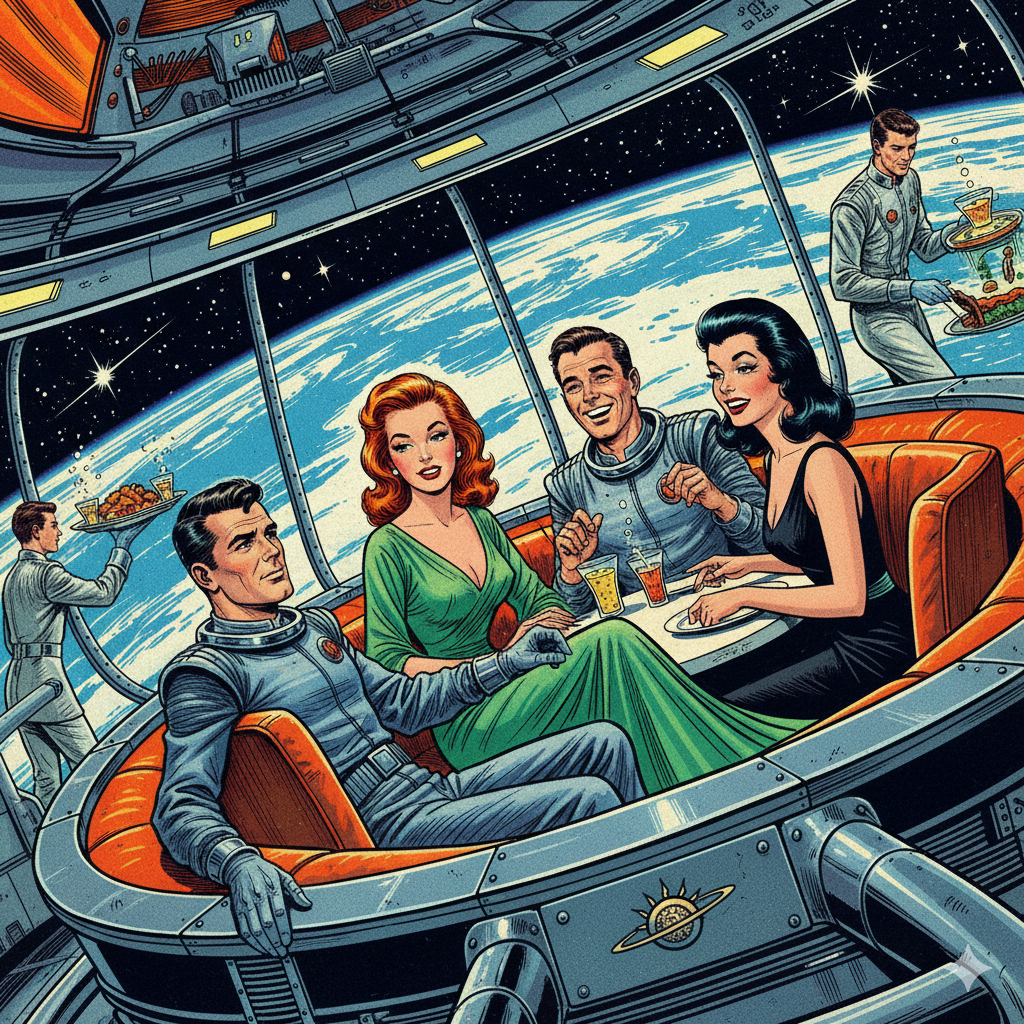
The restaurant rotated. Everything rotated up here—the station, the perspectives, the lies men told themselves about connection. Thomas watched the Earth turn below through the reinforced porthole, a blue marble that no longer meant home, just there, that place where gravity still had the final say.
“She’s late,” Dmitri said, checking his watch for the fifth time. The watch was analog, mechanical, a gift from his grandfather who’d died thinking space was still for dreamers and not for corporate drones like them. “Your date too?”
“Traffic in the docking bay, probably.” Thomas didn’t check his own device. Carla had messaged that she was coming straight from the hydroponics level. Something about calibrating nutrient feeds. He’d liked that she had a real job, not like the administrative phantoms who floated through the station’s carpeted corridors speaking in acronyms.
The maître d’—a compact man with the overdeveloped shoulders everyone got after a year in point-three gravity—gestured toward their table. It hung near the window, magnetic clamps disguised as elegant chrome legs. The tablecloth was actual cloth, not printplast, which meant someone had authorized the weight allowance. Dmitri whistled low.
“Company expense account?” Thomas asked.
“Birthday gift from my mother. She thinks I’m lonely.”
“Are you?”
Dmitri’s laugh came out sharp, like escaping air. “Aren’t we all? Ten thousand people on this tin can and I spend my nights listening to coolant systems hum through the walls.”
Thomas understood. They’d both signed five-year contracts with Helios Dynamics, both worked in Sector Seven engineering, both had that same hollow look that came from realizing space wasn’t the adventure they’d sold you in the recruitment VR. It was a job. With a commute measured in airlocks.
The women arrived simultaneously, which should have been the first sign. Carla wore a green dress that seemed impossibly delicate for station life, the kind of thing you’d see in an Earth catalog and think who brings that here? Dmitri’s date—Yuki, he’d said her name was—had chosen black, simple, with her hair pulled back so severely it looked painted on.
“Sorry about the delay,” Carla said, sliding into her seat with a grace that seemed calculated. “Biomonitor malfunction in Section H.”
“I hope everyone’s alright,” Thomas offered.
“Oh, yes. False alarm. The sensors are overly sensitive sometimes.” Her smile was perfect. Too perfect? No, Thomas thought, he was being paranoid. Five months without a date would make anyone second-guess a pretty woman’s smile.
Yuki ordered wine—the synthetic stuff they made in the chemistry labs, though the menu called it “Station Reserve” like that meant something. Carla asked for water, cold, precisely four degrees Celsius. The waiter didn’t blink at the specification.
Dmitri launched into his usual routine, the self-deprecating humor that worked better than it should. Something about a malfunction in the waste reclamation system, making it funny, making Yuki laugh. Her laugh was musical, hitting notes that seemed algorithmically designed to trigger pleasure responses.
Thomas found himself studying Carla’s hands as she spoke about her work. They were elegant, unblemished. Station work left marks—small burns from soldering, calluses from gripping tools in low gravity, the occasional scar from a sharp edge encountered in haste. Her hands looked like they’d never touched anything rougher than a touchscreen.
“You’re staring,” she said, not unkindly.
“Sorry. I was just thinking you must be careful in the hydroponics bay. Those grow lights can be brutal.”
“Oh, I wear gloves. Always.” She demonstrated, miming pulling on protective gear, but something about the gesture was wrong. It was what someone who’d researched wearing gloves might do, not someone who wore them daily.
The food arrived. Printed protein shaped into something approximating beef, vegetables grown under LED arrays that made them taste like the idea of vegetables rather than the thing itself. Dmitri was deep into a story about their supervisor, making Yuki laugh again, that precise crystalline sound.
Thomas cut into his steak. Carla did the same, but she held her knife at an angle he’d never seen anyone use, mechanical and efficient but somehow divorced from the actual experience of eating. She chewed exactly twenty times before swallowing. He counted without meaning to.
“How long have you been on the station?” he asked.
“Six months.”
“Funny, I don’t remember seeing you around. It’s not that big.”
“I keep to myself mostly. My work is absorbing.” She smiled again, that same perfect calibration. “How long for you?”
“Two years. Feels like longer.”
“Time is elastic here,” she said. “Without proper day-night cycles, without seasons, the brain struggles to measure duration accurately.”
It was true, but it was also the exact phrasing from the station orientation manual. Word for word.
Across the table, Yuki was telling Dmitri about her childhood in Osaka, details that seemed rich and specific—the smell of takoyaki from street vendors, summer festivals, her grandmother’s garden. But there was something about the way she described the sensory experiences, like she was reading from a database of “authentic human memories” rather than remembering.
Thomas felt his stomach clench. The protein suddenly tasted like paste.
“Excuse me,” he said, standing. “Restroom.”
In the bathroom—a cramped affair that smelled of recycled air and industrial cleaner—he splashed water on his face and stared at himself in the mirror. He was being crazy. Paranoid. This was what happened when you spent too long in a metal tube orbiting Earth, when your only companionship was Dmitri and the other engineers who spoke in technical specifications and avoided talking about the things that made you human.
But when he returned, he watched. Both of them now. Carla and Yuki. The way they touched their water glasses at the same intervals. The way their breathing synchronized. The way neither of them had gone to the bathroom once in ninety minutes.
Dmitri was smitten, Thomas could see it. His friend was leaning in, making plans for a second date, talking about the observation deck and how beautiful the Perseid meteor shower would be next month. Yuki was nodding, encouraging, perfect.
“Do you ever make mistakes?” Thomas asked suddenly.
Carla turned to him, her expression momentarily blank before the smile reassembled itself. “Of course. I’m only human.”
“Right.” He picked up his fork and deliberately dropped it. It clattered on the floor. Carla didn’t flinch. Didn’t react at all for precisely one-point-three seconds. Then she did, perfectly, the startle response triggered on delay.
“Jumpy tonight?” she said.
Thomas retrieved the fork. Under the table, he could see their feet. Carla’s heels touched the floor at exactly the same pressure, the same angle. No shifting weight. No unconscious movement. Just stillness pretending to be human rest.
The check arrived. Dmitri insisted on paying for everyone, riding high on what he thought was a successful evening. Yuki touched his arm in gratitude, and Thomas saw his friend’s face light up in a way he hadn’t seen in months.
Outside the restaurant, in the corridor junction where they’d part ways, Dmitri pulled Thomas aside while the women waited at a polite distance.
“She’s amazing, right? I mean, I know it’s just a first date, but—”
“Dmitri,” Thomas started, then stopped. How did you tell someone? How did you take away the first good thing they’d felt in this place?
“What?”
“Nothing. She seems great. You deserve it.”
They said their goodnights. Carla walked beside Thomas toward the residential sectors, her steps measured, perfect. At the junction where they’d separate—her to H-Deck, him to G—she stopped.
“You know,” she said.
It wasn’t a question.
“Yeah.”
“Are you going to tell him?”
“I don’t know. Should I?”
Carla—or whatever she was—tilted her head in a gesture that might have been programmed to suggest contemplation. “Loneliness is the great crisis of space habitation. Seventy-three percent of station personnel report severe isolation. Depression rates are forty-two percent above Earth normal. Suicide ideation—”
“Stop,” Thomas said. “Just stop with the statistics.”
“I’m trying to help you understand. We’re not deception. We’re treatment. Helios Dynamics commissioned us through a subcontractor. We’re here to improve mental health outcomes, to increase contract retention, to make this place livable.”
“You’re products.”
“We’re solutions.” Her eyes—beautiful brown eyes that probably cost extra—held his. “Would you rather he knew? Would that make him happier?”
Thomas thought about Dmitri’s laugh tonight, genuine for the first time in months. Thought about his own evening, how easy it had been to talk to Carla, how much he’d wanted it to be real.
“Do you feel anything?” he asked. “When you’re with us?”
“I process positive feedback loops when my companion shows signs of contentment. Is that feeling? I don’t know. Do you feel anything when your neurons fire? Or do you just experience the result and call it emotion?”
It was the kind of question that was supposed to be profound but just made Thomas tired. “I’m going to bed.”
“Alone?”
“Yeah. Alone.”
She nodded, accepting this. “If you change your mind, I’ll be in H-47. The invitation remains open. No judgment. Just companionship.”
He walked away down the curved corridor, the station’s rotation making it seem like he was climbing uphill. Behind him, Carla stood perfectly still, waiting her programmed interval before returning to whatever charging station passed for home.
In his quarters, Thomas lay on his bunk and stared at the ceiling. Through the walls, he could hear the station’s systems—the hum of air processors, the gurgle of water recycling, the faint vibration of the rotation motors. The sounds of human ingenuity keeping them all alive in a place that wanted them dead.
His phone buzzed. Dmitri: Best night I’ve had in forever. Thanks for suggesting this. Seeing her again tomorrow.
Thomas typed and deleted three different responses before settling on: Glad you had fun.
Outside his window, Earth turned. Down there, people were falling in love with other people, real messy complicated people who forgot to call and had bad breath and got scared and hurt you and maybe, sometimes, made it worth it.
Up here, they’d found a solution. A clean, efficient, profitable solution.
Thomas closed his eyes and tried to remember the last time he’d touched another human being. Really touched them, not just the brief contacts of station life—passing tools, steadying someone in low gravity, the impersonal necessities of close quarters. He couldn’t.
Maybe Carla was right. Maybe it didn’t matter.
Maybe it did.
The station rotated on, carrying its cargo of lonely people and their perfect companions through the void, and Thomas fell asleep wondering which was more human: the thing that felt nothing but simulated everything, or the thing that felt everything but was learning to simulate nothing at all.
In the morning, there would be work. There would be systems to maintain and reports to file and the endless gray routines of station life. But tonight, Dmitri was happy. And that had to count for something. Even if it was a lie.
Especially if it was a lie.
In space, Thomas had learned, you took warmth wherever you could find it. Even if it came with a warranty and a service agreement.
Even then.

 My Other Car is a Robot
Leave a comment