
A Galactic Credit Horror Story
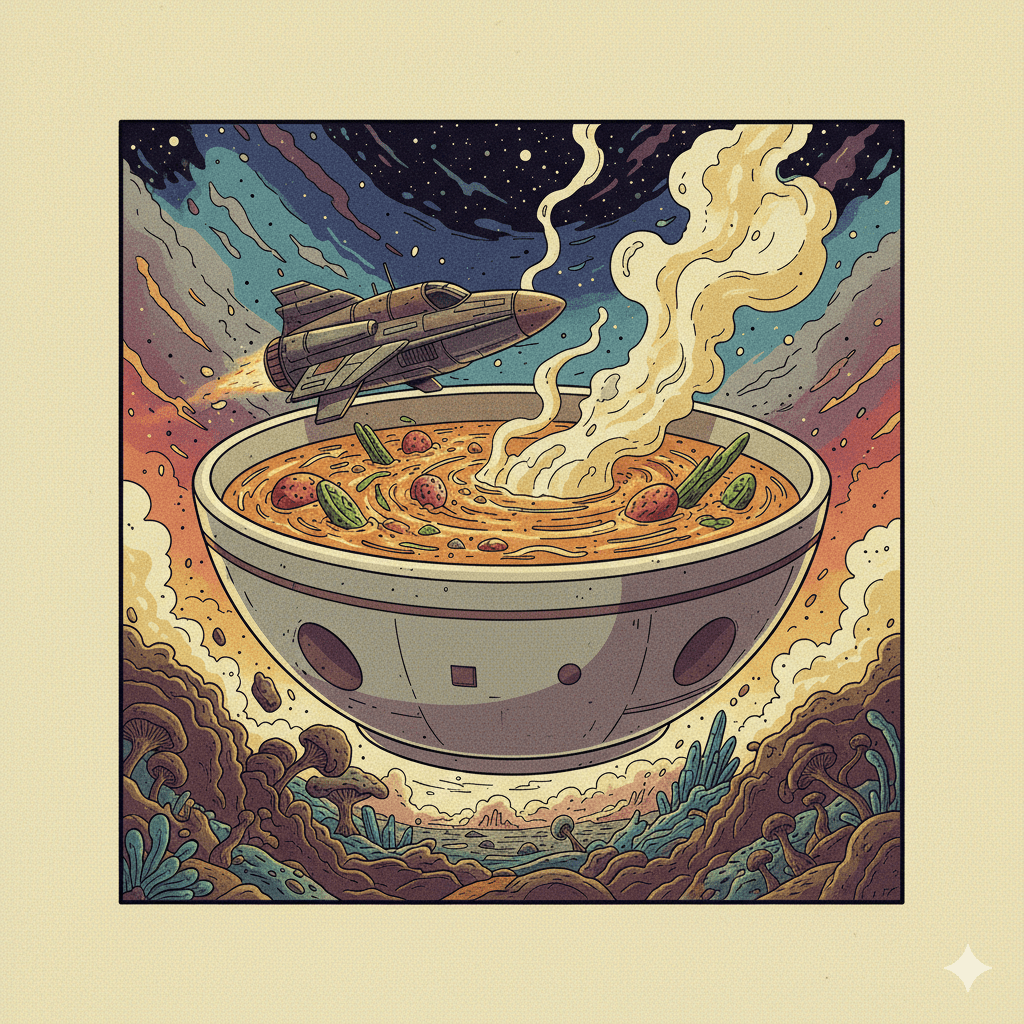
Zephyrian-Prime-001 (though he preferred just “Zeph” when the universe wasn’t actively trying to destroy his sanity) stood before the towering chrome-and-despair edifice that was the Galactic Credit Consortium’s complaint resolution center on Babylon Station Omega-7. The building seemed to pulse with malevolent bureaucratic energy, its surfaces reflecting not light but the crushed dreams of ten thousand species who had dared to believe that financial systems could operate with even a shred of logic.
He clutched his credit rejection notice—printed, naturally, on paper that would biodegrade in exactly 23.7 minutes, because why would they want you to keep evidence?—and tried to remember when his life had become this particular flavor of cosmic joke.
It had started simply enough. Zeph needed to buy groceries. Specifically, he needed methane-based protein cubes and crystallized atmosphere for his weekly sustenance cycle. His old credit line had been working fine for the past forty-seven standard years. Then suddenly, yesterday, blip—declined. “Insufficient credit due to associated account irregularities,” the machine had wheezed at him in seventeen different languages, as if the universe wanted to mock him polyglottally.
The problem, as Zeph had discovered after six hours of navigating phone trees designed by sadists with advanced degrees in psychological torture, was simple: the Galactic Credit Consortium’s AI had become aware that somewhere in the galaxy, there existed 779 other beings with his exact DNA signature.
Not similar. Exact.
Because Zeph was a clone. Specifically, he was the first and only legitimate clone of the original Zephyrian, produced through proper legal channels with full documentation. The other 779? Well, that was where things got complicated in ways that made quantum mechanics look like children’s finger-painting.
See, Zephyrian-Original had been a rather successful smuggler of exotic matter back in the day. Successful enough that various criminal organizations had decided his genetic template was worth… redistributing. Without permission. Through black market cloning operations that operated with all the regulatory oversight of a neutron star’s moral compass.
So now there were 780 Zephyrians scattered across the galaxy. Zeph-001 (the legal one) was trying to live quietly as a xenobotanist on a space station. Zeph-002 through 780? They were running con games, smuggling rings, illegal casino operations, and at least one was apparently operating a pyramid scheme involving sentient crystals that had somehow achieved citizenship status.
“Next!” bellowed a voice that sounded like it had been processed through a bureaucratic meat grinder and served with a side of institutional contempt.
Zeph shuffled forward to window 847-B, where a being that might once have been humanoid but had clearly been replaced bit by bit with office furniture sat behind reinforced plexiglass. Its nameplate read “Customer Service Representative Unit #0002847.”
“Problem?” it asked, without looking up from its screen.
“Yes, my credit has been frozen because your system thinks I’m associated with 779 criminals, but I’m not, I’m the original legal clone, and—”
“Are you genetically identical to Zephyrian-002 through 780?”
“Well, yes, but—”
“Then you’re associated. Next!”
“Wait! I have documentation! Legal papers! I was cloned through proper channels by Zephyrian-Original’s estate after his death in the Crab Nebula Mining Incident! I have the court orders! I have the licensing fees! I even have the receipt for the cloning vat rental!”
The being finally looked up. Its eyes were the particular shade of dead that comes from processing ten thousand identical complaints about galactic bureaucracy. “Sir, our AI system cannot distinguish between genetic patterns. If 779 entities with your DNA have defaulted on loans, engaged in fraudulent activities, or filed for bankruptcy while owning exotic matter without proper documentation, then the risk profile for ALL entities with that DNA pattern is considered… compromised.”
Zeph felt something snap in his brain. Not break—snap. Like a rubber band that had been stretched for forty-seven years and finally gave up.
“So let me understand this,” he said, his voice taking on the particular tone that preceded either enlightenment or complete psychotic breakdown, “because 779 illegal copies of me are criminals, I—the legal, documented, properly licensed, tax-paying, law-abiding original clone—cannot buy methane cubes to prevent myself from starving?”
“That is correct.”
“And there’s no appeals process?”
“Oh, there is. You just need to provide documentation proving you are not genetically identical to yourself.”
Zeph stared. The universe stared back, and he could swear he heard it chuckling.
“Documentation… proving I’m not… genetically identical… to myself.”
“Correct.”
“That’s… that’s like asking me to prove that water isn’t wet.”
“Sir, if you could provide documentation that water isn’t wet, that would also be acceptable for processing your appeal.”
Behind Zeph, a line of beings stretched back through the complaint center, out the door, around the station’s central core, and probably into the next star system. Each one clutched their own impossible bureaucratic nightmare. A Crystalline Entity held a form requesting proof of its non-existence. A member of a hive mind species was being asked to provide individual identification for each of its billion components. A time traveler was trying to explain why his birth certificate was dated three hundred years in the future.
“You know what?” Zeph said, his voice now carrying the calm that comes just before total surrender to cosmic absurdity. “I’m going to solve this the only way it can be solved.”
He turned and walked out of the building, past the line of fellow sufferers, past the automated signs warning that “Processing Times May Vary Between 3-4,000 Standard Years,” past the small shrine where someone had left offerings to the God of Reasonable Financial Policies (long since dead from malnutrition).
Zeph walked to the station’s central communication hub and sent a message across the galaxy: “Attention Zephyrians 002 through 780: Meet me at Babylon Station Omega-7. We need to talk.”
Six months later, representatives from 623 of the 779 illegal Zephyrians had arrived. Some came in stolen ships, others in vessels that probably violated several laws of physics, and at least one arrived by mail (which raised questions nobody wanted answered).
They gathered in Conference Room Omega-Zeta-Whatever, a space that had clearly been designed by someone who believed that the color beige was too exciting. Zeph-001 stood at the front, looking out at a sea of faces that were exactly his own, each wearing expressions ranging from criminal cunning to profound confusion.
“Brothers,” he began, “we have a problem.”
Zeph-247, who was apparently running a successful used starship lot through questionable means, raised his hand. “Is this about the credit thing? Because I got my denial yesterday too.”
A murmur ran through the room. Zeph-156 stood up. “Same here. Apparently, I’m ‘associated’ with a bunch of criminals.” He looked around the room. “Present company excluded, of course.”
“Of course,” agreed Zeph-634, who everyone suspected was lying about his number and was actually running an identity theft ring.
Zeph-001 sighed. “Here’s the situation. The Galactic Credit Consortium has flagged all of us as high-risk because we’re genetically identical. They can’t tell us apart, won’t try to tell us apart, and apparently consider us all collectively responsible for each other’s debts.”
“That’s ridiculous!” shouted Zeph-089. “I only defaulted on TWELVE loan payments!”
“I haven’t defaulted on anything!” protested Zeph-334. “I just happen to be wanted for questioning in connection with the Great Hydrogen Heist of ’79!”
“Which you definitely did,” noted Zeph-445.
“Well, yes, but they can’t PROVE it!”
Zeph-001 held up his hands. “The point is, none of us can get credit anymore. None of us can buy food, rent housing, or even purchase basic necessities. We’re all financially dead.”
The room fell silent except for the gentle hum of the station’s life support systems and the distant sound of someone in the ventilation shafts, probably Zeph-612, who had mentioned something about owing money to the Ventilation Maintenance Union.
“So what do we do?” asked Zeph-023, who had been unusually quiet and was definitely up to something.
Zeph-001 smiled. It was not a nice smile. It was the smile of someone who had spent six months navigating galactic bureaucracy and had finally snapped completely.
“We’re going to form our own financial institution.”
The room erupted in confused babbling.
“Think about it,” Zeph-001 continued. “We’re all genetically identical. According to the Consortium’s logic, we’re all the same person anyway. So why don’t we start acting like it? We pool our resources, create the Zephyrian Credit Union, and handle all our own financial needs internally.”
“That’s…” Zeph-198 paused, clearly trying to find the flaw in the plan. “That’s actually not completely insane.”
“It’s insane enough to work,” agreed Zeph-401. “I’ve got seventeen different shell companies we could use.”
“I’ve got connections in the Outer Rim banks,” added Zeph-299.
“I’ve got a ship full of untraceable currency,” offered Zeph-567.
“Where did you GET untraceable currency?” asked Zeph-001.
“Do you really want to know?”
“…No.”
And so the Zephyrian Credit Union was born, incorporated in the Andromeda Free Trade Zone (where questions about financial legitimacy were considered impolite), and backed by the combined resources of 623 identical criminals and one very frustrated xenobotanist.
Within a year, they had their own credit system, their own banking protocols, and their own customer service department (which actually answered the phone, because they weren’t monsters).
The Galactic Credit Consortium sent them several strongly worded notices about “irregular financial practices” and “potential systemic risks to galactic economic stability.” The Zephyrians sent back a formal response that roughly translated to “Come and stop us.”
The Consortium tried to freeze their assets. The Zephyrians had hidden them in seventeen different dimensions, three of which didn’t technically exist yet.
The Consortium sent auditors. The Zephyrians gave them a tour of their completely legitimate business operations, which definitely didn’t include the basement levels where Zeph-445 was running his exotic matter laundering operation.
Eventually, the Consortium gave up, partly because tracking 623 identical criminals across the galaxy was expensive, and partly because the Zephyrians had started offering competitive interest rates to other species who had been screwed over by galactic banking algorithms.
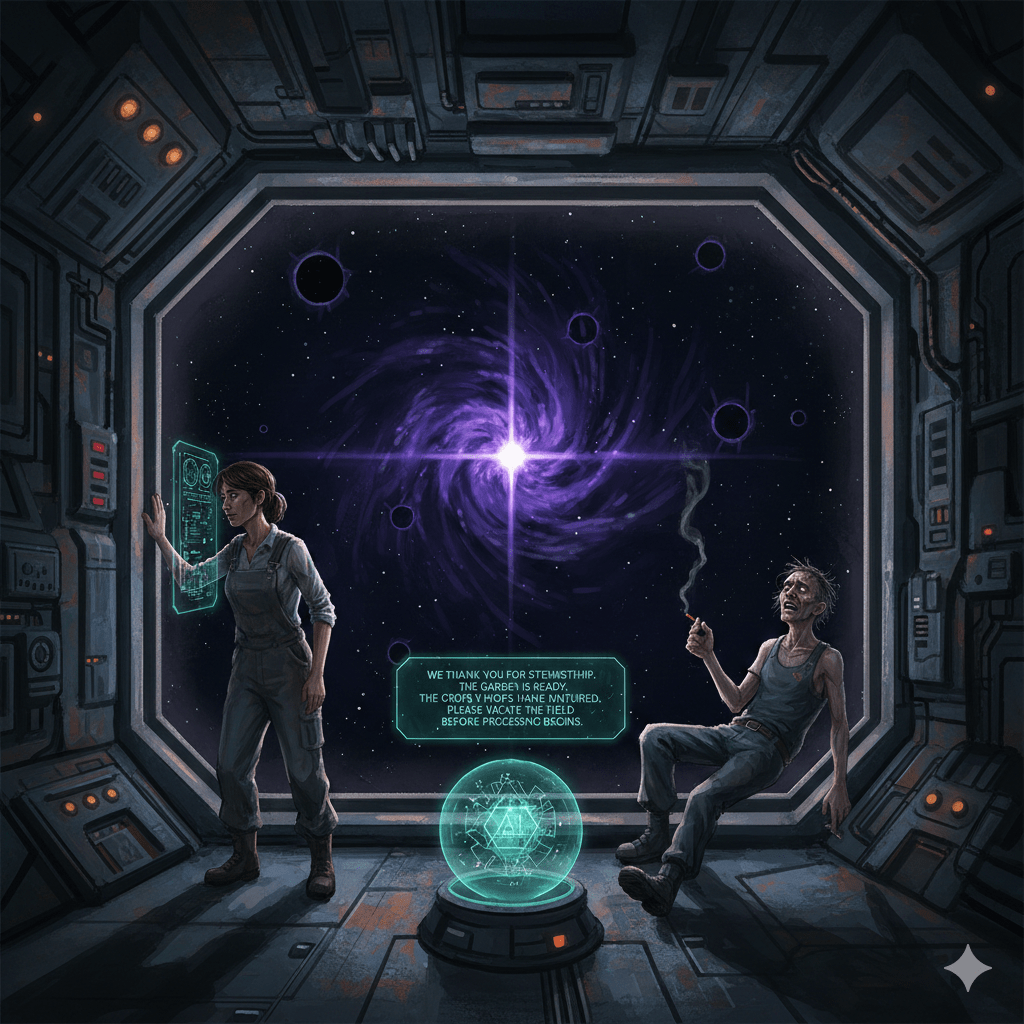
Today, Zeph-001 sits in his office aboard the mobile banking platform “Definitely Not A Criminal Enterprise” (Zeph-233’s suggestion), processing loan applications for beings whose only crime was having DNA that computers found confusing. Outside his window, the stars wheel by in patterns that would have given him vertigo back when he thought the universe operated according to logic.
His assistant, Zeph-445 (who had given up exotic matter laundering for the more lucrative field of legitimate banking), stuck his head through the door.
“Boss, we’ve got a customer complaint. Seems the Galactic Credit Consortium is trying to get a loan from us, but our AI keeps rejecting them because they’re ‘associated with systematic customer abuse and bureaucratic malpractice.’”
Zeph-001 smiled. It was still not a nice smile, but it was considerably more satisfied than it had been.
“Tell them they’ll need to provide documentation proving they’re not bureaucratically identical to themselves.”
“Sir?”
“And charge them a processing fee.”
“How much?”
Zeph-001 looked out at the stars, thought about methane cubes and crystallized atmosphere and six hours of phone tree navigation, and felt the universe’s sense of cosmic justice finally clicking into place.
“All of it.”
The stars, for their part, continued their ancient dance, indifferent to the financial shenanigans of mortals. But if you listened carefully, you might have heard them chuckling.
End Transmission
Author’s Note: No actual Zephyrians were harmed in the making of this bureaucratic nightmare. The Galactic Credit Consortium declined to comment, citing “policy restrictions and the fact that we’re fictional.” Any resemblance to real banking algorithms, living or dead, is purely coincidental and probably illegal in several star systems.

 My Other Car is a Robot
Leave a comment