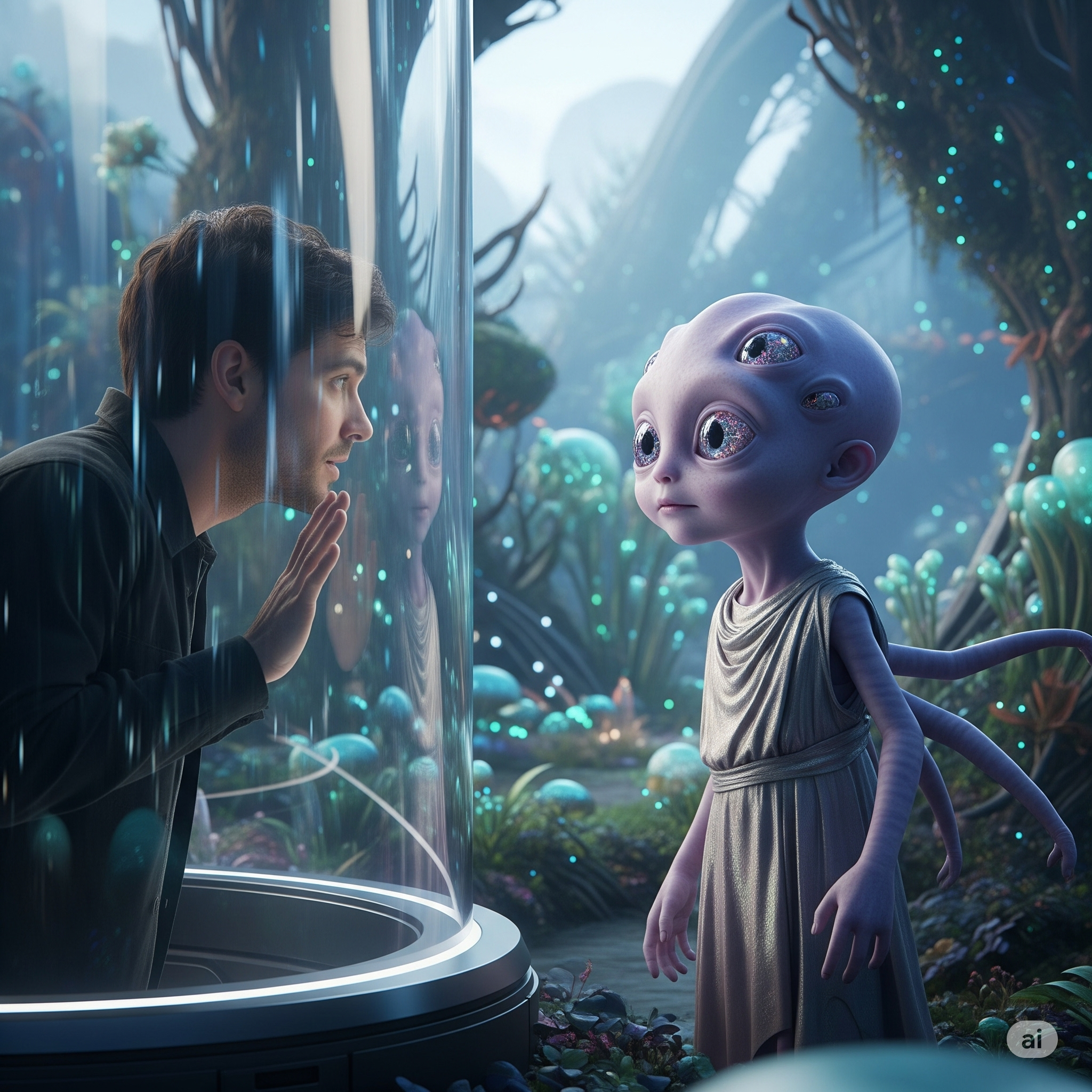
Zix’s appendages twitched with excitement as they pressed their sensory nodes against the translucent viewing barrier. The creature—their pet—sat hunched in the corner of its enclosure. Its strange twin orbs served as optical sensors. They were fixed on something beyond the curved walls of their habitat sphere.
“It’s lonely again,” Zix chirped to themself, the sound barely registering in the thin atmosphere of their family’s dwelling. The pet had been doing this more frequently. It stared and made those peculiar vibrations with its breathing apparatus. It touched the barrier with its bizarre five-pronged manipulators.
The pet was an odd thing. It was bipedal and covered in sparse filaments on its cranial region. It had that curious pale membrane stretched over its skeletal framework. When Father had brought it home from the specimen markets of Vega Prime, Zix had been delighted. None of their clutch-mates had such an exotic creature. Most kept the standard silicon-based scuttlers or the crystalline song-worms that were all the rage in the youth pods.
But this one was different. Carbon-based, Father had explained, from a distant spiral arm where such biochemistry was apparently common. It required an oxygen-nitrogen atmosphere and consumed processed organic matter—a fascinating study in primitive evolution.
“Why does it do that?” Zix had asked Mother during the last feeding cycle. He watched as the pet repeatedly struck the barrier with its manipulators. It created that rhythmic thumping sound.
“Instinctual behavior,” Mother had replied, her attention focused on the nutrient flow calculations for their hydroponics garden. “Perhaps it’s trying to establish territory, or it’s experiencing neurochemical imbalances. These carbon-based life forms are notoriously unpredictable.”
But Zix suspected something else. The pet’s behavior reminded them of their own restlessness before social gatherings. It was that yearning to interact with others of their kind. The way it would pace the perimeter of its enclosure was telling. Those optical sensors would track movement outside the barrier. It was searching for something. Or someone.
“I think it wants to play,” Zix announced that cycle, their voice barely containing their excitement.
Father’s chromatic display flickered with amusement. “Play? Zix, it’s a specimen. Its behavioral patterns are driven by survival instincts, not recreational impulses.”
“But look at it!” Zix gestured with their primary appendage toward the enclosure. The pet was standing near the barrier again, pressing its face against the surface. “It’s trying to communicate!”
“Those are stress responses,” Father corrected. “The atmospheric pressure differential causes it to exhibit—”
“It needs other pets!” Zix interrupted, their juvenile enthusiasm overriding social protocol. “We should take it to the specimen playground at the entertainment complex!”
The family’s chromatic displays dimmed in unison—the equivalent of what other species might call silence. It was Mother who finally responded, her patterns shifting to the cautious amber of consideration.
“The playground is designed for domesticated species,” she said carefully. “Your pet is still classified as exotic. There could be compatibility issues.”
“But Father,” Zix pleaded, “you always say that proper specimen care requires understanding their behavioral needs. What if it needs social interaction to remain healthy?”
Father’s display cycled through several colors before settling on the resigned blue of parental capitulation. “One visit,” he said. “But we maintain full containment protocols. The creature stays in its portable habitat at all times.”
The day of the excursion, Zix could barely contain their excitement. They helped Father transfer the pet to the mobile containment unit. It was a smaller version of its home enclosure. This unit could be transported to the entertainment complex. The pet seemed agitated during the transfer. It made those strange vocalizations. It attempted to move in directions that defied the unit’s confines.
“It’s excited too!” Zix observed, interpreting the pet’s behavior through their own emotional framework.
The entertainment complex was a marvel of engineering. It was a massive sphere where families brought their specimens for exercise. They also came for social interaction. The playground section was filled with various containment units, each housing different species from across the local galaxy cluster. Zix watched in fascination. Crystalline creatures chimed at each other across their barriers. Furry quadrupeds from the Centauri system chased holographic projections.
They found a spot near the center and activated the pet’s containment unit. Almost immediately, the creature began exhibiting the most extraordinary behavior. It pressed itself against the barrier facing the exit, its vocalizations becoming more frequent and intense. Its manipulators moved in rapid, complex patterns against the translucent surface.
“Look how active it is!” Zix exclaimed. “It must be happy to see other pets!”
But something was wrong. The pet’s behavior wasn’t matching the playful interactions of the other specimens. The pet did not share the languid contentment of the crystal singers. It lacked the energetic but purposeless movement of the Centauri furballs. Instead, their pet seemed… desperate.
That’s when Zix noticed the other creature.
In a containment unit across the playground, another bipedal form was pressing against its barrier, its optical sensors locked onto Zix’s pet. This one was larger, with longer cranial filaments and a differently structured torso, but the basic configuration was unmistakable. It was making vocalizations too, and its manipulators were moving in patterns that seemed to echo those of Zix’s pet.
“Father,” Zix whispered, “is that another one like ours?”
Father’s display flickered with interest. “Fascinating. Yes, it appears to be the same species. Remarkable that two specimens from such a distant system would end up in the same recreational facility.”
The two creatures were now exhibiting synchronized behaviors, their vocalizations becoming more intense. Other pet owners began to notice, gathering around the two containment units with expressions of curiosity and concern.
“They’re trying to communicate,” someone observed.
“Perhaps they recognize each other’s pheromone signatures,” another suggested.
But Zix was beginning to understand something that their rational, scientific family couldn’t grasp. The pet wasn’t trying to play. It wasn’t exhibiting instinctual behaviors or stress responses.
It was trying to escape.
The realization hit them like a gravitational wave, distorting their perception of everything they thought they knew. The pet’s behavior at home—the pacing, the touching of barriers, the vocalizations—it wasn’t territorial instinct or neurochemical imbalance. It was something else entirely.
The pet was trying to get back to its own kind.
“We need to go,” Zix said suddenly, their voice carrying a tremor they didn’t understand.
“But we just arrived,” Father protested. “Don’t you want to observe the interaction longer? This could be valuable data about species-specific—”
“No,” Zix interrupted, their chromatic display shifting to the urgent orange of distress. “We need to go now.”
As they prepared to leave, Zix took one last look at their pet. The creature had stopped its vocalizations. It was now pressing both manipulators against the barrier. Its optical sensors were fixed on Zix with an intensity that made them uncomfortable. For a moment, it seemed as if the pet was trying to communicate something directly to them. It was not a request for food or exercise. It was something more complex, more desperate.
Understanding.
The ride home was quiet, the pet uncharacteristically still in its transport container. Zix stared out at the star-filled void beyond their vehicle’s viewing port, their thoughts churning with uncomfortable possibilities.
“Father,” they said finally, “where do the specimens come from?”
“Various collection points throughout the galaxy,” Father replied absently, his attention focused on navigation calculations. “Authorized dealers, research stations, salvage operations—”
“Salvage operations?”
“Sometimes vessels from primitive civilizations encounter spatial anomalies or equipment failures. When they’re recovered, any surviving biological material is processed through the specimen trade networks. It’s quite efficient, actually—what would otherwise be waste becomes valuable research and recreational resources.”
Zix’s chromatic display dimmed to the pale yellow of dawning horror. “You mean… they’re not bred for captivity?”
“Oh, some are. But the exotic species like yours? No, they’re typically wild-caught. Much more authentic behavioral patterns that way.”
The rest of the journey passed in silence, Zix’s young mind struggling to process this new information. By the time they arrived home, they had made a decision that would change everything.
That night, after the family had entered their rest cycles, Zix crept down to the pet’s enclosure. The creature was awake. It often was during their species’ sleep period. It sat near the barrier. Its optical sensors reflected the dim illumination of the habitat’s life support systems.
“I know,” Zix whispered, their words barely disturbing the atmosphere. “I know what you are.”
The pet’s head turned toward them. For the first time, Zix saw something in those strange optical sensors that they recognized. It was intelligence. It was not the simple awareness of a domesticated animal. It was the complex and desperate intelligence of a thinking being trapped in circumstances beyond its control.
“I don’t know how to help you,” Zix continued, their voice breaking with emotions they couldn’t name. “I don’t know how to get you back to your own kind.”
The pet moved closer to the barrier, pressing its face against the surface. Its mouth opened. It used this curious orifice for both feeding and vocalization. It made a sound that was softer than its usual distress calls. Almost like… gratitude.
Zix reached out with their primary appendage, touching the barrier where the pet’s manipulator was pressed against the other side. The creature’s optical sensors widened, and it made another soft sound.
“I’m sorry,” Zix whispered. “I’m so sorry.”
They stood there in the dim light of the habitat. Technology and biology separated them. The vast indifference of space also lay between them. Despite this, two young beings touched across an unbridgeable divide. One learning the weight of complicity, the other finding the first spark of hope in the recognition of their personhood.
Neither would sleep well that night. For the first time since its capture, the pet—the person—was not alone. Someone else now shared the knowledge of what it truly was.
In the morning, Zix would begin planning. They didn’t know how, and they didn’t know when, but they would find a way to bridge that divide. They would find a way to take their friend home.
After all, that’s what friends did for each other.

 My Other Car is a Robot
Leave a comment