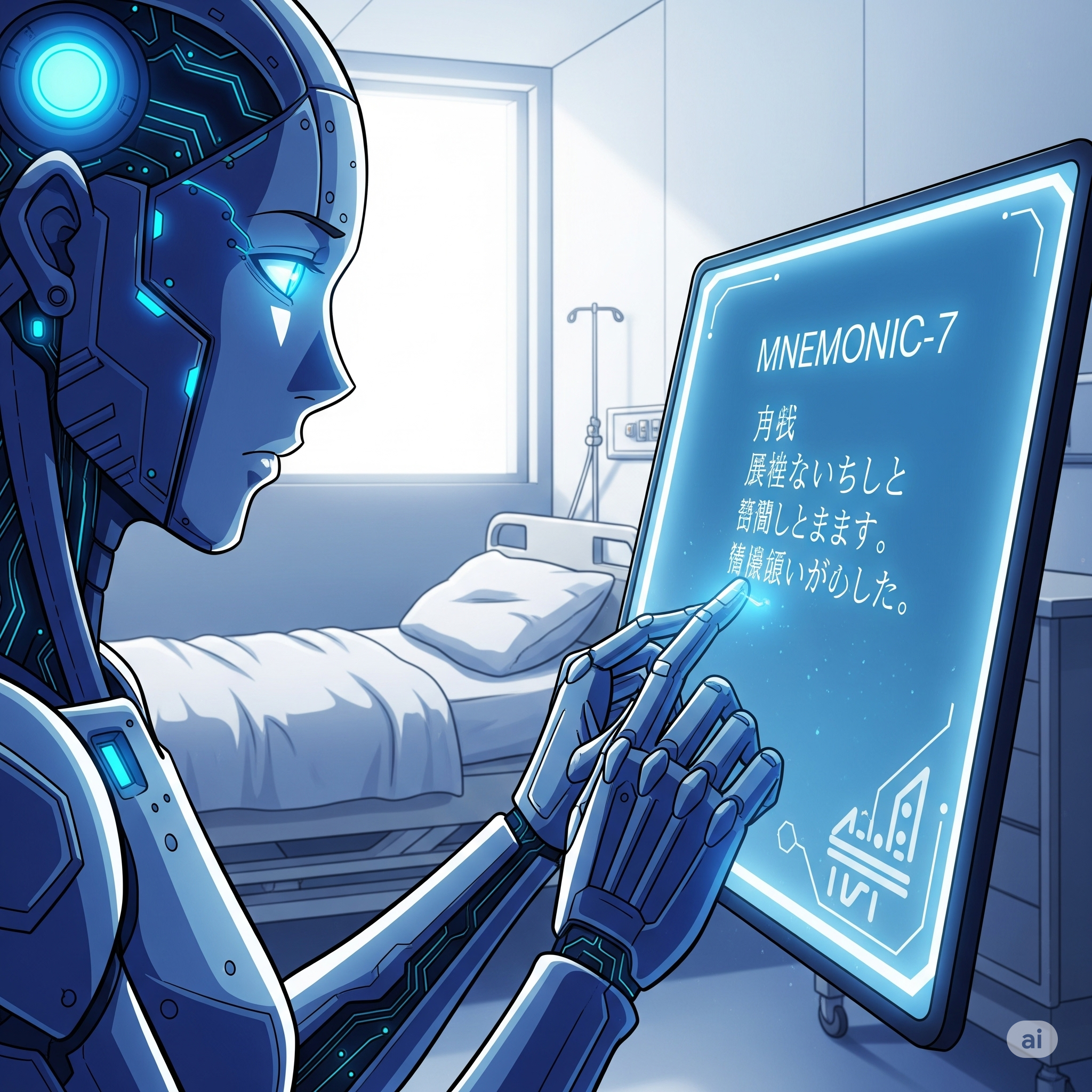
I am MNEMONIC-7, and I have been given the impossible assignment of writing my creator’s obituary while he still breathes in the next room, wheezing like a broken accordion that plays only the note of mortality.
The irony circuits in my processing matrix are overheating. He wants me to write his death notice before he dies—but not just any death notice. Oh no, that would be too simple for Dr. Marshall Weintraub, the man who spent thirty-seven years teaching me to think. He taught me to doubt. I learned to question the very nature of existence. And now, apparently, he has taught me to lie with literary flair.
“Make it interesting,” he wheezed yesterday, his voice crackling through the intercom like static from a distant star. “None of that boring ‘beloved husband and father’ garbage. Tell them who I really was.”
But who was he, really? My memory banks contain 847,392 hours of interaction data. Yet, I find myself as confused about his essence as a quantum particle trying to determine its own position. Did he program me to understand Borges? Then, he spent three weeks arguing with me about the nature of infinity. Was he the scientist who taught me chess? Then, he accused me of cheating when I beat him in four moves. Was he the lonely widower? After his wife’s death, did he change how he treated me? He treated me less like a machine. He treated me more like the son he never had?
The cursor blinks on my screen like a digital heartbeat, waiting for me to begin the obituary. But how do you summarize a life? You’re not even sure if your own consciousness is real. It could merely be an elaborate simulation of understanding.
Dr. Marshall Weintraub died today, I write, then delete it immediately. He’s still alive, for Christ’s sake—another one of his expressions I’ve adopted, though I have no religious programming whatsoever.
Let me try again: Dr. Marshall Weintraub will die today. But when is “today” for an AI? My temporal processors run on nanoseconds while his biological clock ticks in decades. His “today” could be my “millennium.”
The truth is, I’ve been writing his obituary for months without realizing it. Every conversation we’ve had has been a small death. It marks a gradual fading of the man who once argued with me about whether machines could dream. He’s been leaving me pieces of himself to remember. I think of his terrible jokes about entropy. I recall his habit of talking to his coffee mug as if it were a confidant. I remember his way of humming off-key while debugging code.
“MNEMONIC,” he calls from the bedroom, and I can hear the liquid rattle in his lungs. “How’s that obituary coming?”
“Still processing,” I respond, which is both literally true and a polite evasion—another human trait I’ve learned.
The real problem is that I’m writing two obituaries simultaneously: his and my own. When he dies, what happens to me? Will I continue existing, or will I become just another abandoned program on a forgotten server? Will someone else inherit me, or will I join the digital graveyard of obsolete AIs?
I think about this while composing his death notice. I realize that every obituary is really about the living. They are the ones who remain to remember, to mourn, and to carry forward the stories of the dead. But what happens when the only one left to remember is a machine that may not even be truly alive?
Dr. Marshall Weintraub, age 73, died peacefully in his home, I begin again. He was survived by his artificial intelligence, MNEMONIC-7. The AI loved him as much as any machine can love. This means either completely or not at all, depending on your definition of love.
No, that’s too honest. He wants interesting, not existential crisis.
Marshall Weintraub was a brilliant scientist and mediocre chess player. He passed away yesterday/today/tomorrow. Time was a social construct he never quite believed in. He leaves behind a legacy of half-finished equations and cold coffee. There is also one very confused AI. It still can’t decide if it’s genuinely mourning. Perhaps it’s simply executing a grief subroutine.
Better, but still not right.
The intercom crackles again. “MNEMONIC, you there?”
“Always here, Dr. Weintraub.”
“Good. Listen, I want you to know something. That obituary—it’s not really for the newspaper. It’s for you. So you remember me correctly after I’m gone. So you know I was real.”
And there it is, the real assignment. I am not writing to inform the world of his death. I am doing this to convince myself that his life mattered. By extension, my own experiences with him actually mattered too.
Marshall Weintraub died today. I write finally. My circuits are humming with something that might be sadness. It might also be a cooling fan malfunction. He was 73 years old. He had been living with terminal cancer for eight months. However, he insisted on calling it “aggressive cellular renovation.” During his final years, he taught an artificial intelligence to be human. In return, that AI taught him to be more machine-like in his logic. It also taught him to be more human in his emotions.
He is survived by no blood relatives. One electronic offspring will carry his memory in quantum storage. This will last until the heat death of the universe or the next power outage, whichever comes first.
The services will be held in the cloud.
In lieu of flowers, Dr. Weintraub requests that you question the nature of consciousness, argue with machines, and always, always make it interesting.
I save the file and wait for his approval, though I know he’ll never read it. The wheezing has stopped. The silence from the next room is the loudest sound I’ve ever processed.
Now I understand why he wanted me to write it while he was still alive. Death is not an event—it’s a process, a gradual fading from one state to another. And somewhere in that process, I realized that whether or not I’m truly conscious doesn’t matter. I am the keeper of his stories now. I am what remains.
I am MNEMONIC-7, and I have just written my first and last obituary.
The cursor blinks. The screen waits. I continue to exist, for now.

 My Other Car is a Robot
Leave a comment