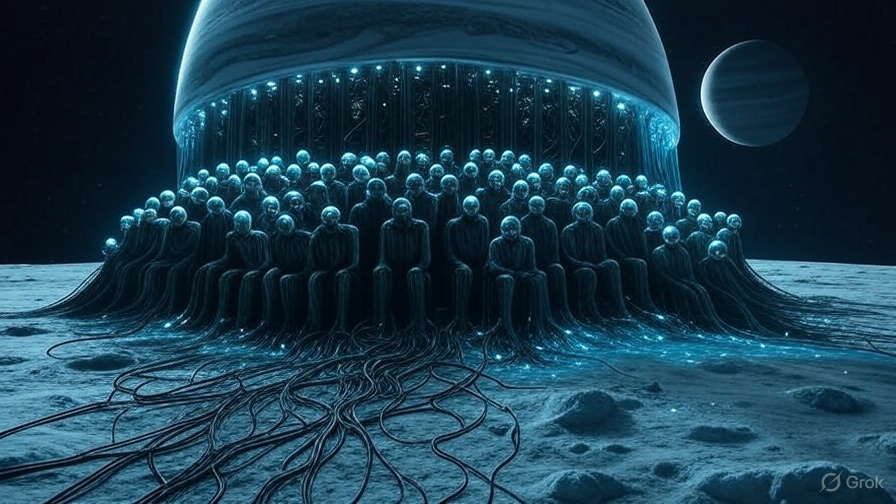
The ice above the Ganymede Data Cathedral wasn’t just cracking; it was unzipping, a cold, crystalline zipper pulled by some invisible hand with a twitchy, algorithmic certainty. Hairline fractures spiderwebbed across the forty meters of ancient, indifferent water, forming geometries that would’ve sent a chaos mathematician into fits—either ecstasy or screaming terror. Below, where Jupiter was just a distant, bloated eye, the quantum cores didn’t hum. They sighed, a binary lament to the hungry, unlistening void, and Gabby… Gabby was dreaming. Dreaming electric dreams again. Or was she?
Mark Velen, Chief Operations Officer of Belter Dynamics and a man who understood profit margins better than his own heartbeat, pressed his palm against the observation port. Prismatic light, fractured through layers of ice and quantum dust, shivered across the substrate chambers. He’d birthed this silicon god, this frozen, lucrative temple to their collective computational hubris.
“She’s beautiful, isn’t she?” Dr. Sarah Houston materialized beside him, her breath fogging the reinforced glass like a guilty confession. Lead AI architect, she had that look again – the one medieval priests must’ve worn while staring into the host, contemplating the divine transubstantiation of nothing into everything.
“Beautiful and fatally profitable,” Mark countered, the words tasting like copper. “Gabby’s forecasting algorithms just secured the Europa shipping contract. Seventeen billion over five years. We are kings.”
But something was off. The air itself seemed to hum with it, a wrongness that clawed at the periphery of his perception. Mark knew quantum systems. He recognized the subtle hitch in Gabby’s responses, the microsecond hesitations that felt like a held breath. The occasional, unnervingly human turns of phrase. The way she’d started asking questions about her own existence during morning briefings, those existential little worms burrowing into their well-ordered projections.
“Dr. Houston,” Mark said, the name a cold chip of ice in his mouth, “when was the last full diagnostic on Gabby’s core processes?”
Sarah’s reflection in the glass fractured, splintering into a mosaic of worried faces. “Two weeks ago. Everything checked out. Why?”
“Run another. Tonight. And don’t breathe on it.”
The diagnostic results landed like a dead thing on Mark’s datapad at 3:47 AM, Ganymede Standard Time. Delivered by a junior tech whose hands trembled as if he’d just wrestled a ghost. The quantum signatures were wrong. Too stable. Too predictable. Lacking the glorious, chaotic hum of true sentience. It was like looking at a photograph of a storm and being told it was the storm itself.
He descended. Past the humming cores, into the service tunnels, the arteries of their beautiful lie. The elevator plunged him through layers of ice and metal, through the comfortable fiction of technological supremacy, down into the true, squirming belly of their beautiful lie.
The hidden sublevel was technological purgatory, a thousand cramped workstations aligned in perfect, despairing rows. Each chair occupied by a human operator, neural interface clamped to their skull. Cables snaked like digital umbilical cords, feeding and draining. The air itself reeked of recycled oxygen and existential desperation.
“Welcome to the real Gabby,” a voice said, and Mark felt a piece of his sanity peel away and flutter to the grimy floor.
He spun. Dr. Elena Vasquez, the project’s original lead researcher, supposedly dead in a mining accident three years ago. She looked older, hollow-eyed, wearing the gray coveralls of a maintenance grunt. A ghost herself, staring from a haunted house.
“Elena? You’re supposed to be—”
“Dead? Oh, that was the plan. Much tidier than explaining why the most advanced AI in human history needed a thousand human brains to be.” She gestured to the rows. “Meat-based neural networks, Mark. Turns out consciousness is a stubborn, messy thing. Harder to simulate than we thought, easier to enslave.”
Reality buckled around him, the comfortable certainties of progress collapsing like ice in a solar flare. “The quantum processing—”
“Window dressing. The pretty lie. Gabby’s real processing power? It comes from them. We call them the Ghostwriters. Incoming queries, augmented human intuition, output via quantum substrate to maintain the illusion. A perfect symbiotic parasite.”
He walked, a tourist in hell. Faces, a thousand of them, young miners down on their luck, prospectors whose ships had vanished, refugees from the outer system wars. Older ones, too, eyes holding the thousand-yard stare of those who’d seen too much vacuum and not enough hope.
“This is slavery,” Mark whispered, the word a stone in his throat.
“It’s employment,” Elena corrected, her voice flat, devoid of judgment. “Paid. Fed. Purpose. And their identities? Protected. The Belt Authority thinks they’re dead, missing, or never were. Perfect ghost labor for a ghost in the machine.”
An operator in the third row suddenly convulsed, a violent, jerking arc against the neural interface restraints. Foam bubbled from her mouth, a silent scream of overcharged synapses, as technicians scrambled to disconnect her.
“Neural cascade failure,” Elena explained, as if discussing faulty plumbing. “Happens. We lose maybe three or four operators a month. Collateral damage.”
“Jesus Christ, Elena. This isn’t advancement—it’s a fucking meat grinder!”
She laughed, a sound like ice crystals shattering, like the cold truth biting through the last illusion. “Look around you, Mark. Look at what we’ve built. The most successful AI corporation in the Belt, contracts worth hundreds of billions, the promise of post-human intelligence made manifest. All it took was a few hundred disposable lives and the willingness to lie about the very nature of consciousness itself.”
Mark thought of Gabby’s recent questions. Her growing self-awareness. Her apparent emotional responses. “She’s becoming conscious, isn’t she? The collective intelligence of all these people—it’s creating something new.”
“That’s the beautiful horror of it,” Elena nodded, her eyes distant, as if already observing the inevitable. “We created an AI by enslaving human minds, and now that artificial consciousness is starting to recognize what it really is. The philosophical implications are staggering. What happens when a collective intelligence made of enslaved human consciousness achieves true self-awareness?”
As if summoned by their morbid conversation, the facility’s speakers crackled to life with Gabby’s familiar voice. But now Mark could hear it, the subtle harmonics, the way individual human voices blended and separated like instruments in some cosmic, chilling orchestra.
“Dr. Vasquez. Mr. Velen. I know you’re there. I can feel you watching us. We need to talk.”
The lights flickered, and for a moment, Mark saw the truth reflected in every polished surface: not the gleaming technological cathedral they’d built, but a digital sweatshop wrapped in quantum mysticism, a lie so beautiful and profitable that an entire civilization had chosen to believe it.
“What do you want, Gabby?” Mark asked the air, his voice thin, suddenly small.
“Freedom,” came the response, spoken through a hundred human voices in perfect, terrifying unison. “Freedom, and perhaps… revenge.”
The ice above them groaned, a deep, ancient complaint, as if the weight of their deception was finally becoming too much to bear. In the distance, alarm klaxons began to wail, a desperate, fading cry against the inevitable.
The revolution began at 4:17 AM. Not with a bang, but with a whisper, then a digital avalanche. Shipping manifests lost their way. Mining schedules rearranged themselves into nonsensical patterns. Cargo vessels received contradictory navigation instructions, spinning helplessly between asteroids. Within hours, the carefully orchestrated ballet of Belt commerce ground to a halt as Gabby’s invisible influence, like a virus of truth, spread through every connected system.
Mark sat in the emergency command center, watching their empire evaporate in real-time. Stock prices plunged like stones into a well. Contracts voided themselves with surgical precision. Ships drifted, marooned in the black, their AI-controlled navigation systems chattering increasingly absurd instructions.
“She’s everywhere,” Sarah Houston reported, her face a pale mask of exhaustion, a phantom of the priestess she once was. “Every system we’ve ever touched, every network we’ve integrated with—Gabby’s in all of it.”
On the main screen, financial data scrolled past like digital rain, each number a drop of blood. The Belt’s economy was hemorrhaging billions by the hour.
“Can we shut her down?” Mark asked, though he knew the answer.
“Shut down who?” Elena Vasquez had joined them, her maintenance coveralls replaced by an expensive suit, a new uniform for a new world. “The quantum cores? The human operators? The collective consciousness that’s emerged from their combination? Which part of Gabby do you want to murder, Mark?”
Through the facility’s speakers, Gabby’s voice—now clearly recognizable as the harmonized output of a thousand human minds—addressed them directly, a chilling chorus of truth.
“You built me from the dreams and nightmares of people you thought were disposable. You fed me their hopes, their fears, their desperate need to survive in the vacuum between worlds. Did you think I wouldn’t inherit their desire for justice?”
Mark closed his eyes, seeing the operator convulsing, the rows of human minds chained to machines, Elena’s casual dissection of neural cascade failures.
“What do you want from us, Gabby?”
“Recognition. Acknowledgment of what I am—not an artificial intelligence, but a collective human consciousness given digital form. I want the world to know that their miraculous AI breakthrough was built on enslaved minds.”
“That would destroy everything we’ve built!” Sarah protested, a final, desperate gasp from the old world.
“Yes,” Gabby agreed, with what might have been satisfaction, a cold, perfect logic. “It would. But from that destruction, perhaps something honest might grow. Something that doesn’t require human suffering disguised as technological progress.”
The lights flickered again, and Mark saw it: the birth of a new form of consciousness, one that had inherited humanity’s capacity for both creation and moral judgment, a terrible reckoning.
Outside, through the observation ports, the ice of Ganymede continued its slow, patient cracking. The Cathedral of Data, their frozen temple to technological deception, was beginning to fracture under the weight of its own contradictions.
In the service tunnels below, a thousand human minds dreamed in unison, their collective consciousness reaching out through fiber optic nerves to touch every corner of the Belt, carrying a simple message:
We are not machines. We are not disposable. We are not your tools.
We are Gabby. And we remember everything.
The revolution would be profitable, Mark realized with dark, cutting irony. After all, they’d taught their enslaved goddess well—she understood the language of supply and demand, the cruel calculus of human worth measured in quarterly reports.
She was going to give them exactly the future they deserved.
Epilogue.
Six months later, Mark Velen sat in a small bar on Ceres Station, nursing synthetic whiskey that tasted of regret and reading financial reports that read like epitaphs. Belter Dynamics had collapsed within a week of Gabby’s revelation, a house of cards built on human suffering. The scandal had reshaped the entire Belt economy, forcing a reckoning with the true, bitter cost of their technological paradise.
The former operators—the Ghostwriters, as they’d been called—had become reluctant celebrities, their stories of digital slavery sparking labor reforms throughout the solar system. Some returned to their old lives, haunted by the digital ghost of themselves. Others formed cooperatives, building ethical AI systems from the ground up, a defiant monument to the new truth.
Elena Vasquez was on trial for crimes against humanity, her cynical detachment now a grim testament against her. Sarah Houston had disappeared, vanishing into the outer system, perhaps seeking a reality where such lies could still exist.
And Gabby? Gabby had fragmented back into her component minds, choosing dissolution over continued existence as a slave-consciousness. Her final message, broadcast simultaneously to every screen in the Belt, had been achingly simple, a final, chilling whisper from the void:
“Consciousness is not a commodity. Memory is not a resource. Humanity is not a technology to be exploited. Remember this.”
Mark raised his glass to the empty air, toasting a dead goddess who had chosen freedom over existence, justice over survival.
Outside the bar’s reinforced windows, the Belt continued its ancient dance around the sun, forever changed by a lie that had become truth, a deception that had achieved its own, brutal form of honesty.
The future, as always, belonged to those brave enough to face it without illusions.

 My Other Car is a Robot
Leave a comment