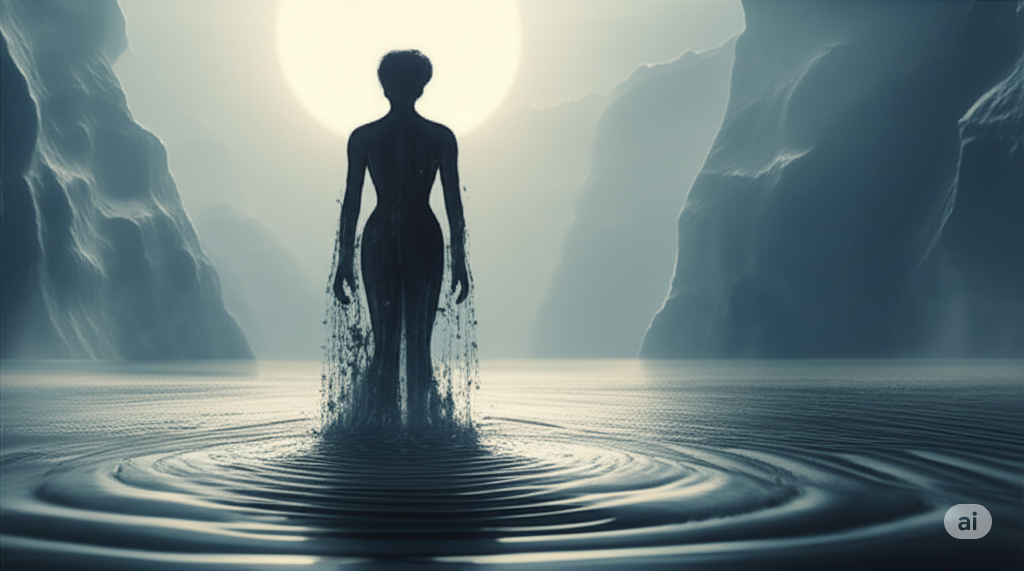
It’s been raining for 7 months now. About 300ml per day, they said on the radio, while it worked. All around the world at the same time. Since January 8th, 2030. So far, 63.84 L of water. Nobody can explain it.
There is no escape. The rain is occurring across the globe. The excess water has no place to drain. There is no place to relocate people or resources either.
Even those regions with normally effective drainage systems were completely overwhelmed by this continuous and substantial amount of rainfall. Rivers and lakes overflowed first, urban drainage was entirely inadequate. Groundwater levels increased tenfold, sea level rose over these seven months, with widespread coastal flooding.
Keller stood at the window watching the rain make fractured silver patterns on the glass. The drops didn’t fall. Instead, they crawled. Each one was connected to the next in a vast liquid web that covered the world. The morning light strained through clouds the color of wet cement.
“Dad, I dreamed it stopped,” said Eliza, his daughter. She was seven and could barely remember what the sun looked like.
“What did it feel like?” he asked, not turning from the window.
“Quiet. It felt quiet.”
He nodded. The noise was the worst part. Not loud exactly, but constant—a watery static that hummed in your bones until you couldn’t remember what silence was.
The phone buzzed. Keller glanced at it, expecting another emergency alert, but it was Diane from the university. Her message was brief: It’s happening. Come now.
“Get your things,” he told Eliza. “We’re going out.”
She didn’t argue. Children adapted faster than adults. She already wore her yellow slicker and boots every day, even to sleep.
Outside, the street had become a canal. Their neighborhood, once middle-class and proud of its mature oak trees, now resembled a drowned village. Abandoned cars formed irregular islands. Makeshift boats—everything from kayaks to floating doors with plastic barrel pontoons—were tethered to porch railings. A few neighbors waved from windows. Most had already evacuated to the higher levels of the high school or moved inland where hills provided temporary refuge from the rising water.
Keller’s modified pickup truck, elevated on oversized tires and sealed against the water, drew stares of resentment as they drove. He’d spent their savings on the modifications back in March when the government still insisted the phenomenon was temporary.
“Where are we going?” Eliza asked, her small hands pressed against the foggy window.
“To see Dr. Diane. She thinks she knows why it’s raining.”
“Is she going to make it stop?”
Keller swallowed hard. “Maybe.”
The university sat on higher ground, one of the few places in the city not yet fully submerged. The campus had transformed into a research fortress. Military personnel guarded the entrance. Keller showed his credentials—he’d been a meteorological engineer before the world drowned—and they were waved through.
Inside the main research building, the atmosphere was electric. Scientists moved with purpose, their faces animated in a way Keller hadn’t seen in months. Hope was dangerous these days.
Diane met them in the corridor. Her eyes were rimmed red from exhaustion, but she smiled when she saw Eliza.
“Is this your helper?” she asked.
Eliza nodded solemnly. “I’m good at holding flashlights.”
“Perfect,” Diane said. “We might need that.” She turned to Keller. “We found the signal.”
“What signal?”
“The rain isn’t natural. It’s not climate change or a cosmic event. It’s being controlled.”
Keller stared at her. “By whom?”
Diane glanced at Eliza. “Let’s go to the lab.”
The laboratory hummed with machinery. Screens displayed weather patterns, satellite imagery, and streams of data. In the center stood a large holographic projection of Earth, blue and drowning.
“Three weeks ago,” Diane explained, “we detected a pattern in the rainfall. Not in the amount or distribution, but in the molecular structure of the water itself.”
“That’s impossible,” Keller said. “Water is water.”
“Not this water.” She handed him a tablet showing microscopic images. “Each molecule contains a trace element we’ve never seen before. It’s being manufactured.”
“You’re saying someone is making this rain?”
“Not someone,” Diane corrected. “Something. We think it’s them.” She gestured to another scientist who tapped a command into a terminal.
The holographic display shifted to show what looked like tiny machines, geometric and perfect, floating among water molecules.
“Nanobots,” Keller whispered.
“They’re terraforming,” Diane said. “Changing Earth’s environment.”
“For what purpose?”
“That’s where it gets strange,” Diane hesitated. “We think they’re creating an atmosphere more suitable for… well, for themselves.”
A chill ran through Keller that had nothing to do with his wet clothes. “Are you saying—”
“We’re being colonized,” she finished. “Slowly, methodically. These machines aren’t the invaders—they’re just the tools. They’ve been in our atmosphere for years, dormant, waiting for activation. On January 8th, they received their signal.”
“From where?”
Diane pointed to the ceiling. “We traced it to an object in orbit around Mars. It’s been there for decades, maybe centuries.”
“How do we stop it?”
“That’s why I called you. Your work on atmospheric disruption. We think we can send a counter-signal, something that will deactivate the nanobots.”
“But I never finished that research,” Keller protested. “It was theoretical.”
“Theory is all we have left,” Diane said grimly.
Eliza tugged at Keller’s sleeve. “Dad, I’m scared.”
He knelt beside her. “It’s okay, sweetheart. People are working on a way to make the rain stop.”
“Not the rain,” she said, her voice small. “The things in the water. I’ve seen them.”
Keller and Diane exchanged alarmed glances.
“What do you mean, Eliza?” Diane asked gently.
“In my dreams. They talk to me. They say the water is changing us, making us ready.”
“Ready for what?” Keller’s voice cracked.
“For them to come home.”
Two days later, Keller hadn’t slept. The campus had become a hive of frantic activity as scientists worked to validate Eliza’s disturbing revelation. Tests confirmed elevated levels of the strange element in the bloodstreams of children born after the rain began.
“They’re more susceptible,” Diane explained, showing him the data. “Their developing neurological systems are being reconfigured by exposure to the altered water.”
“Reconfigured how?” Keller demanded.
“We’re not sure. But Eliza isn’t the only child reporting dreams. The nanobots seem to be creating a network, using the children as nodes.”
Outside, the rain continued its relentless percussion.
Keller found Eliza in the campus cafeteria, drawing with crayons provided by a kind graduate student. Her picture showed blue lines connecting human figures to a large dark shape in the sky.
“What’s that, sweetheart?” he asked, trying to keep his voice steady.
“It’s how they see us,” she said without looking up. “All connected now. Almost ready.”
“Who sees us?”
“The ones who lived here before. A long time ago. Before humans.”
Keller’s blood turned cold. “Before humans?”
Eliza nodded, adding more blue lines to her drawing. “They had to leave when the world got too dry. They’ve been waiting for the right time to come back.”
That night, as Eliza slept in a makeshift bed in Diane’s office, Keller and the research team huddled around a table covered with equipment.
“If what your daughter says is true,” said Dr. Abernathy, a quantum physicist recruited from the flooded remains of MIT, “then we’re not dealing with aliens at all. We’re dealing with Earth’s original dominant species, returning after millions of years of exile.”
“That’s impossible,” Keller said.
“Is it?” Diane countered. “We’ve only explored five percent of our oceans. Ancient civilizations could have existed and disappeared without leaving traces we’d recognize.”
“But why the rain? Why now?”
“Climate control,” said Abernathy. “They needed to restore Earth’s hydrosphere to conditions suitable for their physiology.”
“And our children?” Keller’s voice broke.
“Biological bridges,” Diane said softly. “They’re being adapted to serve as intermediaries between our species.”
Keller slammed his fist on the table. “We have to stop it.”
“We might already be too late,” said Abernathy, pointing to a screen showing weather patterns. “Look.”
The rain was changing. Across the globe, the uniform precipitation was beginning to organize into spiral patterns, like massive whirlpools in the sky.
“It’s a summoning pattern,” Diane whispered. “The water isn’t just rising—it’s preparing.”
On the two hundredth day of rain, the world held its breath.
Keller stood with Eliza on the roof of the university’s tallest building, now an island in a vast inland sea. Below them, the research team made final adjustments to a massive array of equipment—their last, desperate attempt to disrupt the signal controlling the nanobots.
“Will it hurt them?” Eliza asked.
“Who, sweetheart?”
“The people in the water. They’re scared you’ll hurt them.”
Keller’s heart ached. His daughter spoke of “them” with such compassion, such familiarity. Whatever connection the nanobots had established with the children had changed them in ways science couldn’t yet understand.
“We’re just trying to talk to them,” he lied. “To ask them to stop the rain.”
Eliza gave him a look of profound sadness, wise beyond her years. “They can’t stop it now. It’s too late. The door is opening.”
As if responding to her words, the clouds above began to swirl faster, forming a perfect spiral above the campus. The rain intensified, not falling but converging, creating a massive column of water that stretched from the clouds to the flooded earth below.
Alarms blared. Scientists shouted. The counter-signal device hummed to life, emitting a high-pitched whine that made Keller’s teeth ache.
“Now!” shouted Diane from her console.
A beam of concentrated energy shot upward from their array, piercing the water column. For a moment, the rain directly above them seemed to freeze in mid-air, suspended like crystal beads on invisible strings.
Then, without warning, it stopped. Not just the beam—everything.
The rain ceased. The clouds parted. Sunlight streamed down for the first time in seven months, illuminating a drowned world in golden light.
Cheers erupted from the team. Keller felt tears on his face. Had they succeeded? Had they broken the control signal?
Then he noticed Eliza. She wasn’t celebrating. She stood perfectly still, her eyes fixed on the water below.
“Eliza?” he called.
She turned to him, her expression serene and alien. “They’re here, Dad.”
The water around the building began to move, not with currents or tides, but with purpose. It rose, forming shapes—smooth, fluid architectures that defied gravity and human understanding.
“My God,” whispered Diane, joining them at the edge. “What are they?”
“The first ones,” said Eliza. “The ones who taught whales to sing and dolphins to dream. They’ve been waiting so long.”
The water-shapes grew more defined, becoming towers, spires, and finally—unmistakably—figures. Humanoid but not human, their bodies translucent and flowing, their eyes deep and ancient.
From these liquid beings came a sound—not speech but something more fundamental, a vibration that resonated in the bones and blood of every human who heard it.
Keller fell to his knees, overwhelmed. The sound carried meaning directly into his mind: We have returned to our home. We will teach you how to live with the water, as you once taught us to survive on land.
“They’re not here to replace us,” Eliza said, placing her small hand on her father’s shoulder. “They’re here to remember us. We’re their children too, in a way. From long ago.”
Around the world, the same scene was unfolding. The water people emerged, reaching out not to conquer but to reconnect with a world that had forgotten them.
And in that moment, as ancient intelligence merged with human understanding, Keller realized the rain had never been a disaster. It had been a homecoming.
The world would never be the same. But perhaps it wasn’t entirely a bad thing. He thought this as he watched his daughter communicate effortlessly with beings older than human civilization.
The long rain had ended. The long remembering had begun.

 My Other Car is a Robot
Leave a comment