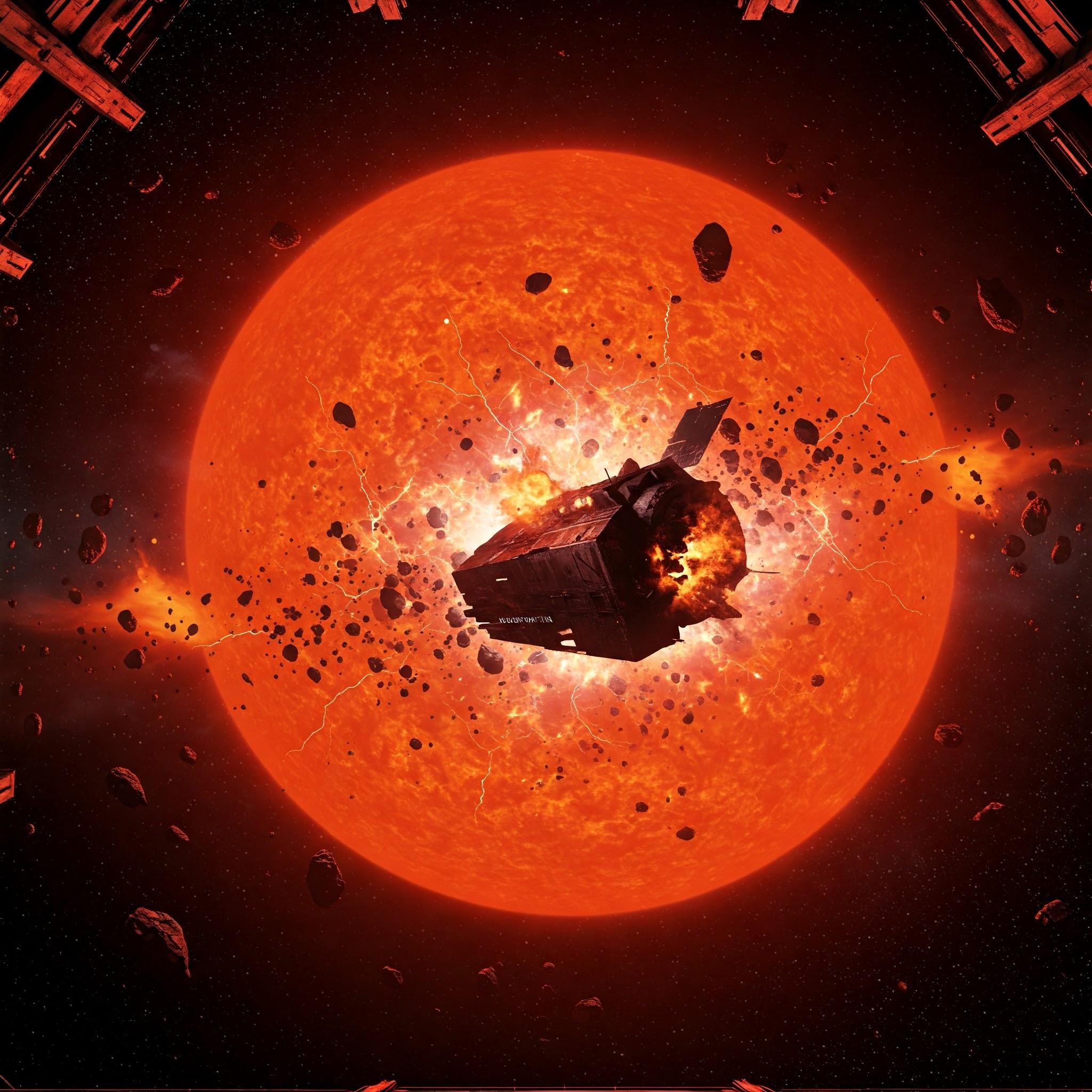
There’s a certain dignity in the death of machines that men have never quite understood. Unlike our messy ends — the rattling breath, the desperate grasping at more time — machines simply stop. Or sometimes, like old Konstantin, they burn.
The ancient ship had been circling Proxima Centauri for fifty-three years. Fifty-three years of silence, of cold metal warming only briefly as it swung too close to the star on its elliptical dance, then freezing again in the vast darkness. The humans who had built it had named it Konstantin, after some forgotten engineer’s grandfather, a man who had once fixed tractors in the Urals. Funny, the things that survive after memory fades.
Marta Saldívar watched from the observation deck of Nueva Buenos Aires station. She was too young to remember when Konstantin had been launched, too young even to remember when contact had been lost. But she had grown up watching that little blinking dot on solar system maps, listening to her father’s stories about the ghost ship that refused to die.
“When I was your age,” her father would say between sips of mate, his eyes reflecting the orange glow of the bombilla, “they said it would fall into the star within the year. Then they said five years. Then ten.” His laugh was always rough, like sandpaper on wood. “Stubborn Russian bastard just keeps orbiting.”
Now, on this ordinary Tuesday, alarms had awakened her at 3:17 station time. The ship was finally falling.
Nueva Buenos Aires was crowded now. Scientists, engineers, and the merely curious pressed against the viewports. Some had apparatus to record the event. Others simply wanted to witness it with their own eyes. Marta had come alone, finding a quiet corner near the back of the observation lounge.
“This is a historic moment,” said the voice of Dr. Cheng over the station’s speakers. “Konstantin represents our earliest attempts at extrasolar exploration. Its mission was ambitious but flawed. The orbital decay we’re witnessing was inevitable, but the fact that the vessel survived in space for over five decades is a testament to the engineering of our ancestors.”
Marta smiled. Always the scientist, turning poetry into facts. But she understood the impulse. Some things were too heavy with meaning to face directly. Like staring at the sun.
Through the viewport, Proxima Centauri pulsed with its familiar red glow, like an ember that refused to die. Konstantin was invisible to the naked eye at this distance, but the station’s external cameras captured it, the image displayed on screens throughout the lounge.
The ship was smaller than Marta had imagined. Just a metal canister with panels and a dish antenna, all of it pitted and dark from years of micrometeorite impacts. In another life, it might have been trash, a discarded coffee can. But someone had dreamed into this object. Someone had placed inside it hopes of discovery, of connection.
“Thirty seconds to projected entry,” announced Dr. Cheng.
The room grew quiet. Someone near the front was weeping softly.
“¿Por qué llorás por un pedazo de chatarra?” muttered a man behind Marta. Why cry over a piece of junk?
But she understood. It wasn’t about the metal or the circuitry. It was about what Konstantin represented: ambition, failure, persistence, and now, finally, an ending.
On the screen, the tiny ship began to glow as it entered the star’s outer atmosphere. First a dull red, then orange, then a brilliant white that hurt to look at even through the screen’s filters.
“Chau, viejo,” whispered Marta. Goodbye, old one.
The heat would be unimaginable. The metal skin that had protected the ship’s delicate instruments from the cold of space for decades was now peeling away like sunburned skin. The computers inside — primitive by today’s standards but once the pinnacle of human achievement — would be melting, their silicon components returning to their elemental forms.
Did machines dream? Did Konstantin, in those last moments, remember the cold factory in Sverdlovsk where it had been assembled? Did it recall the voice of the technician who had tested its systems one final time before launch? Did it know that it had failed in its original mission but succeeded in another — becoming a beacon, a constant, a story told by fathers to their daughters?
Marta liked to think so.
On the screen, Konstantin was gone now, consumed completely. Only a slight disturbance in the star’s atmosphere remained, and soon that too would dissipate, leaving no trace that the ship had ever existed.
The crowd began to disperse. Scientists hurried off to analyze data. The merely curious returned to their quarters or their work shifts. But Marta remained, staring at the red star.
“They had wanted to send it to Venus, you know.”
Marta turned. An old man stood beside her, his face deeply lined, his hair a shock of white against brown skin.
“I’m sorry?”
“Konstantin. Originally it was part of the Venera program. Meant to land on Venus. But something went wrong at launch. The retrorockets misfired. Instead of heading toward Venus, it got trapped in Earth orbit. Then solar winds pushed it further out over the decades until it ended up here.” He gestured toward the viewport. “Funny thing is, those Venera landers that did make it to Venus only lasted about an hour in that hellish atmosphere. Konstantin survived for fifty-three years.”
“Sometimes failure is more interesting than success,” said Marta.
The old man smiled. “Exactly, exactly. Life’s like that too, no? The near-misses sometimes tell us more than the bull’s-eyes.”
He nodded once and shuffled away, leaving Marta alone with her thoughts.
Outside, Proxima Centauri continued its ancient burning. New ships would come, with new missions. Some would succeed, others would fail in spectacular ways, and a few, like Konstantin, would fail so magnificently that they became legends.
Marta pressed her hand against the cool glass of the viewport.
“Ya descansá,” she whispered. Rest now.
And somewhere deep in the heart of the star, the last atoms of Konstantin did just that, finding in death the peace that had eluded them in life, melding with the very forces that had for so long kept them in their endless, lonely orbit.

 My Other Car is a Robot
Leave a comment