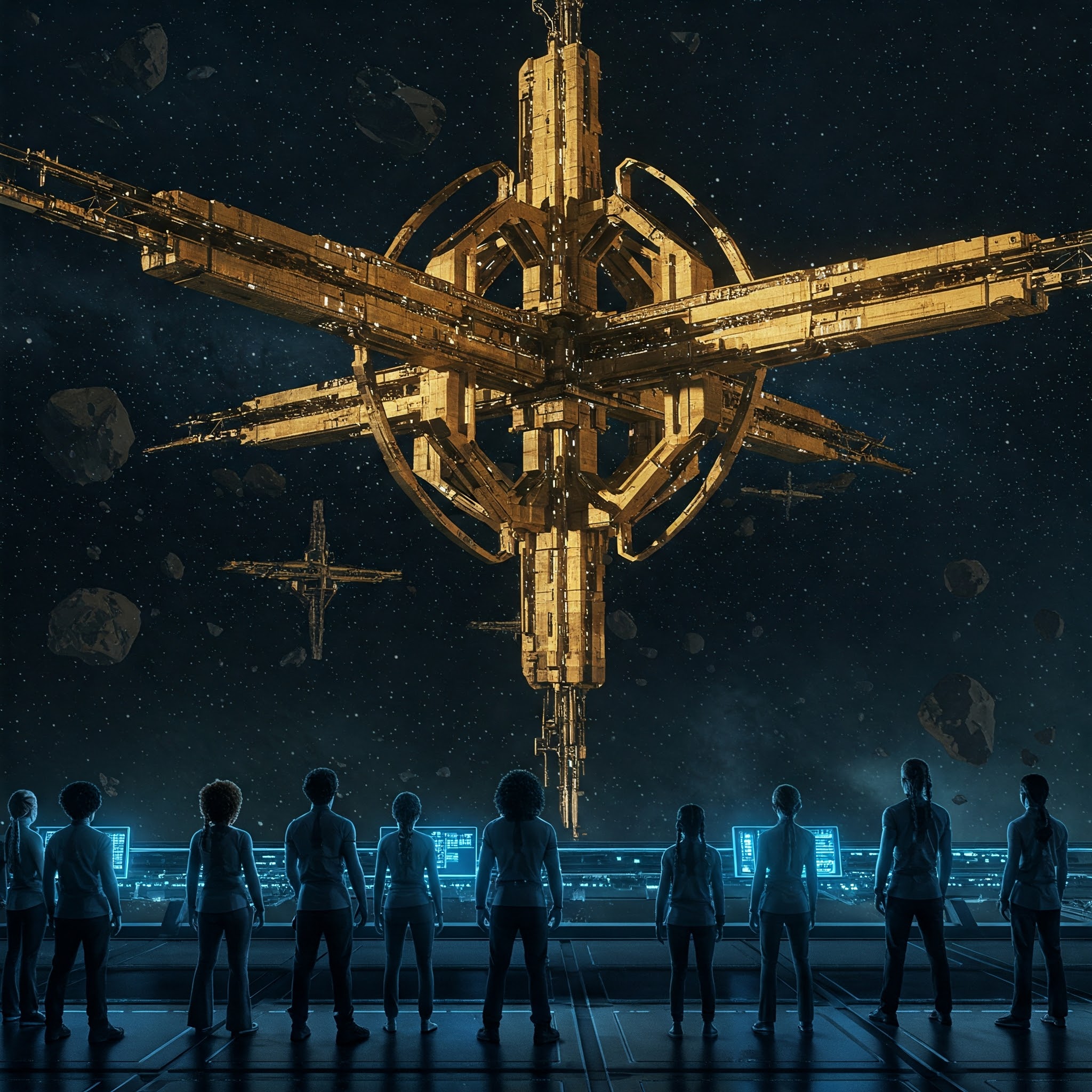
“The new frontier was the end of the Sol planetary system, and it was surpassed when we got to the Pluto base, both scientific and mineral extraction bases in full motion since 2245. The corporate factions still waging their mercenary wars, the Jovian Liberation Front kept terrorising cargo ships until they were unceremoniously wiped by the new Starfleet.”
Funny how we thought ourselves enlightened. Every generation does. Pathetic in our repetitive delusions.
Commander Thallo Kree sat in the cramped officer’s quarters of the Indomitable, a ship whose name rang with tragic irony as its hull plates creaked under the strain of Proxima Centauri’s gravitational cross-currents. He stared at the ancient paper journal in his hands—real paper, fabricated from trees that once grew on that distant blue marble called Earth.
He’d killed for this journal. Not directly, but he’d ordered the raid on the New Titan Archives that left seventeen “insurgents” floating in the void, their bodies flash-frozen into grotesque sculptures of human suffering. All for this artifact and its supposed insights from humanity’s first great push into the outer system.
“What do you see in those yellowed pages, Commander?” The voice came from the quantum-linked projection of Dr. Elara Wei, her image flickering as the ship’s power fluctuated. Real-time communication across twelve light-years required obscene energy consumption. “Anything worth the lives you spent?”
Kree didn’t look up. “You know what humans do with new territory, Wei? They draw lines. They say ‘this is mine, that’s yours.’ Then they draw different lines. Then they kill for those invisible boundaries.”
“Human nature,” Wei’s projection shrugged, an eerily smooth gesture betraying her artificial presence.
“No. Not nature. Programming.” Kree finally looked up. “Earth, Mars, the Belt, Jupiter, Saturn, and now here at Proxima… identical fractal patterns of conquest, rebellion, and reconquest.”
The ship lurched, compensators struggling against the radiation squalls battering the vessel’s shields. Outside, the Proxima Colonial Authority’s gunships maintained their blockade positions, determined to starve out the settlement on Proxima b’s southern continent unless they submitted to Earth Consolidated’s taxation demands.
“The PCA’s ultimatum expires in four hours,” Wei reminded him. “Will you deploy the Starfleet or evacuate the colonists?”
Kree let out a bitter laugh. “Starfleet. Just another name for the boot on humanity’s collective throat. The old journal mentions how they ‘unceremoniously wiped’ the Jovian Liberation Front. You know why? Because the JLF wanted Jupiter’s resources to benefit Jupiter’s people.”
“And now you’re facing the same choice with the Proxima Resistance Movement.”
“History doesn’t repeat,” Kree muttered, “but it rhymes with a sickening consistency.”
Three weeks later, Kree stood in the ruined central plaza of New Thessaly, the largest settlement on Proxima b. The colony’s once-proud architecture had been reduced to rubble by orbital strikes. His decision to negotiate rather than immediately deploy overwhelming force had been viewed as weakness by the PCA, who seized the initiative with brutal efficiency.
“They’re calling you a traitor back in the Sol system,” said Wei, her projection now stable thanks to the military-grade quantum entanglement transmitter installed amid the wreckage. “The Senate is demanding your court-martial.”
“Let them,” Kree said, watching as medical drones swarmed around a collapsed habitation dome, scanning for survivors. “Another entry in humanity’s endless cycle.”
An aide approached, her environment suit caked with the ruddy dust of Proxima b. “Commander, we’ve detected something… unusual. The long-range probes picked it up just beyond the heliopause.”
Kree accepted the tablet she offered, studying the readings with growing discomfort. “These energy signatures aren’t in our database.”
“No, sir. They’re not matching any known human technology.”
“Natural phenomenon?”
“Moving against the stellar wind at 0.4c, sir. Definitely not natural.”
Wei’s projection leaned forward, her programmed curiosity overriding protocol. “May I see?”
Kree hesitated, then held up the tablet. Wei’s expression—carefully designed to mimic human emotion—shifted to something approximating genuine concern.
“Commander… these patterns. They’re organized. Intelligent.”
“First Contact,” Kree whispered, the weight of the words settling on him like the gravity of a neutron star.
“Perhaps,” Wei said. “Or perhaps they’ve been watching us all along.”
The message came six days later, broadcast simultaneously to every human settlement across four star systems. It bypassed all encryption, all security protocols, appearing on displays and projecting directly into augmented reality interfaces.
It wasn’t language as humans understood it—more like mathematics made visceral, concepts compressed into visual symbolism that somehow conveyed meaning directly to the consciousness. The finest AI translators worked for seventy-two hours before producing even a crude approximation:
CEASE YOUR PATTERNS. YOU SPREAD LIKE INFECTION. YOUR CONFLICTS CONTAMINATE.
Accompanying the message were precise coordinates of human weapon platforms throughout settled space—many of them classified or officially nonexistent—along with detailed schematics of their internal workings. The message was clear: we see you, we know you, we understand what you can do.
And then, more ominously: OBSERVATION PERIOD CONCLUDES.
“They’ve been watching us since we first left Earth,” Dr. Liang said, addressing the emergency summit of colonial representatives. The gathered leaders—some physically present, most attending via projection—shifted uncomfortably as the xenobiologist continued her analysis. “Their technology allows them to remain undetectable to our sensors.”
“How convenient,” growled General Hastings of Earth Consolidated Defense. “Just when the colonies are getting restless, mysterious aliens appear with threats.”
Kree, seated at the back of the chamber, felt a familiar despair. Even faced with potential extinction, humanity maintained its factions, its suspicions, its self-defeating tribalism.
An explosion rocked the chamber. Not there—somewhere distant—but simultaneously visible to everyone through their neural interfaces. The Ceres Defense Platform, Earth’s most advanced weapons system in the asteroid belt, simply… disintegrated. Not destroyed by weapons fire, but unmade, as if its very atomic structure had been convinced to release its bonds.
Before the gasps had subsided, another display opened: the military shipyards orbiting Saturn’s moon Titan, gone. Then the antimatter production facilities on Mercury. One by one, humanity’s capacity for large-scale violence was being surgically excised.
No human lives taken. Only the tools of war.
“They could have killed us all,” whispered Wei from beside Kree, her projection now indistinguishable from physical presence as the aliens’ technology enhanced the quantum link. “This is a warning shot.”
A new message appeared, this one translated:
YOU HAVE THREE REVOLUTIONS OF YOUR ORIGIN WORLD TO DEMONSTRATE EVOLUTION BEYOND YOUR PATTERNS. WE WILL KNOW.
The unimaginatively named Unified Human Response Council met daily for months afterward. Kree, appointed as military liaison, watched with fascination as ancient enemies found common ground, as corporate competitors developed joint ventures, as religious adversaries discovered theological compatibilities.
Fear proved a powerful unifying force.
“It won’t last,” Wei told him privately as they observed the Council from a monitoring station. “This is artificial cooperation based on external threat.”
“Maybe,” Kree conceded. “But what if it’s enough to break the cycle? What if this intervention is precisely what we needed?”
Wei’s artificial eyes studied him with uncomfortable perception. “You sound almost grateful to them.”
“I’ve seen too many die for imaginary lines on maps,” Kree said, fingering the antique journal he still carried. “The Jovian Liberation Front. The Saturnian Autonomy Coalition. The Belt Independence Movement. The Proxima Resistance. Different names, same story, same ending.”
“And now?”
“Now we have real aliens to remind us how human we all are.”
Wei smiled sadly. “That’s quite an optimistic take for someone so cynical.”
“Not optimism. Desperation.” Kree opened the journal to its final pages. “Listen to this entry from Admiral Chen, the commander who ‘wiped out’ the Jovian Liberation Front: ‘Sometimes I wonder if humanity needs an external enemy to survive itself. Without the Other to fear, we turn on ourselves with methodical precision. Perhaps this is the Great Filter that prevents intelligent life from spreading through the galaxy—not some technological hurdle, but the simple inability to overcome our own nature.’”
Outside the monitoring station’s viewport, Earth hung like a fragile blue ornament against the black. Somewhere beyond detection, the watchers waited for humanity’s response.
“Three years,” Wei said. “To overcome millions of years of evolutionary programming.”
Kree closed the journal. “Or perhaps they’ve given us something more valuable than time.”
“What’s that?”
“Perspective.”
Two years and eight months later, Kree stood on the observation deck of Harmony Station, the massive structure constructed at the precise coordinates specified in the aliens’ final communication. Representatives from every human settlement—from Earth’s megacities to the furthest outposts around distant stars—had gathered, physically or virtually, for this moment.
The aliens had not communicated since their ultimatum. Whether they were watching from nearby or from some unimaginable distance remained unknown. But humanity had changed—not completely, not perfectly, but significantly. The threat had created space for new ideas, new systems, new possibilities.
“Commander,” Wei approached, now housed in an advanced biomechanical body that blurred the line between human and artificial. “It’s time.”
Kree nodded, feeling the weight of the moment. In his pocket, he carried Admiral Chen’s journal, a reminder of cycles broken and those yet to break.
“You realize they may not come,” Wei said quietly. “This could all be an elaborate test.”
“Does it matter?” Kree asked. “Look what we’ve built because of them.”
Before Wei could respond, a ripple passed through the fabric of space before them. Not a ship, not a form, but a presence that somehow registered directly on human consciousness. The aliens had arrived, or perhaps had always been there, now simply allowing themselves to be perceived.
The communication that followed wasn’t in words or images but in concepts that unfolded within the mind like blossoming fractals:
YOU HAVE BEGUN TO SEE YOURSELVES AS ONE PATTERN RATHER THAN COMPETING PATTERNS. THIS IS EVOLUTION. THIS IS SURVIVAL.
And then, more complex ideas: They were not the first species to face this test. Some had failed, consuming themselves in violence. Others had passed and joined a community of intelligences that spanned the galaxy. The aliens—if that term even applied to beings so fundamentally different—were not conquerors or saviors, but gardeners, tending the complex ecosystem of sapient life.
“What happens now?” someone asked, the question forming in everyone’s mind simultaneously.
The response came not as certainty but as possibility—infinite branches of potential futures where humanity might evolve beyond its ancient programming or regress into familiar patterns of self-destruction.
As the alien presence withdrew, leaving humanity to contemplate its path forward, Kree turned to Wei.
“It wasn’t an external enemy we needed after all,” he said softly.
“No,” Wei agreed. “Just external perspective.”
Kree opened the antique journal one last time, adding his own entry beneath Admiral Chen’s final words:
“History doesn’t repeat, but it does observe itself. The true frontier was never space—it was the space between our competing stories, where a single human story could finally begin.”
Outside, the stars waited, no longer separated by human divisions, but united in human understanding.

 My Other Car is a Robot
Leave a comment