
Another early start, such is the life of cattle herders. I’ve been one even before I was conceived, as my father used to say. He was also a cattle herder, so was my grandfather, a long relationship with cattle. Day in, day out. Moving them to better feeding spots, collecting their dung. Surely, it’s hard work, physical work, my entire body aches after each shift.
But we do what we have to do, what we’ve always done. It’s a family thing, you know. My mother used to tell me about other types of cattle in other ranches. I never quite believed her. Always thought I was being told tales to stop asking questions.
The sky pulses today, shifting between shades of amber and bruised violet that shouldn’t exist in nature. I don’t mention it to the cattle. They wouldn’t understand, or worse—they’d understand too well. My father taught me that rule first: never let them know what you see.
My ocular implant buzzes, projecting the day’s metrics into my left field of vision. Herd count: 212. Nutritional compliance: 88%. Mood stability: fluctuating. I blink twice to dismiss the data. Numbers never tell the whole truth anyway.
“Move,” I whisper, tapping my prod against my thigh. The sound alone is enough. They shuffle forward, bodies swaying in that familiar rhythm, hooves-that-aren’t-quite-hooves pressing into the synthetic soil. The Company calls it “enhanced terraforming substrate.” We call it dirt.
Three kilometers to the eastern feeding quadrant. I walk behind them, watching for stragglers or rebels. There’s always one—usually identity marker C-77, the one with the strange birthmark where its neck meets its shoulder. Looks almost like writing sometimes, if you stare too long. Which you’re not supposed to do.
“Remember the Morales incident,” my father would mutter whenever I asked too many questions. I was twelve when Supervisor Morales disappeared. They said he went back to Earth Central, but his quarters remained sealed for months after. I heard sounds from inside sometimes, passing by on my way to the hygienic chambers. Not human sounds.
C-77 stops, turns its head toward me. Its eyes—too knowing, too deep—lock with mine for exactly three seconds before it resumes walking. Just under the time limit that triggers an alert. Clever. I make a note to watch that one closely.
The Company handbook says their brains are simple, primitive. Capable only of base instincts: eat, sleep, reproduce, fear. But sometimes I wonder. Sometimes, in the deep silence of the artificial night, the habitat dome glows that sickly green. I think I hear them talking.
My wristband vibrates—a message from Central. My heart rate spikes; messages are rarely good news.
“Herder D-23,” the text scrolls across my retina. “Report to Processing Level 4 after shift completion. Routine evaluation.”
Nothing is routine here.
I pocket my prod and pull out the emergency tranquilizer, keeping it hidden in my palm. Last time a herder was called for “evaluation,” his cattle grew agitated by evening, as if they knew. Three broke containment. The Company had to “retire” the entire herd and start fresh.
Ahead, the feeding quadrant comes into view—a vast field of engineered protein-grass that glitters unnaturally under the dome’s light. The cattle quicken their pace, eager. Their enthusiasm seems obscene against my dread.
At the field’s edge stands my supervisor, Keiichi. Not supposed to be here. Not today.
“D-23,” he says, his face as blank as the walls of a decompression chamber. “Good timing.”
“Sir.” I nod, maintaining protocol. “Herd’s at full count. No incidents to report.”
He doesn’t blink. “Your father was an excellent herder.”
Was. Not is.
“Thank you, sir.”
“He understood the importance of distance.” Keiichi’s eyes flick toward the herd, now grazing contentedly. “The necessity of hierarchy.”
My mouth goes dry. “I’ve reviewed his logs extensively.”
“Have you?” He extracts a small device from his pocket—a memory crystal, glowing faintly blue. “We found this in his personal effects. Unauthorized recordings. Observations.”
The crystal catches light, throwing tiny reflections across Keiichi’s expressionless face.
“Apparently,” he continues, “your father had theories about the cattle. About their origins. Their purpose.”
C-77 raises its head suddenly, staring directly at us. At the crystal.
“Sir, perhaps we should discuss this elsewhere,” I manage to say. “The herd—”
“—needs to understand consequences,” Keiichi finishes. He raises his voice. “Cattle are cattle. Herders are herders. The moment we forget the distinction, we risk everything.”
The grazing stops. Two hundred and twelve heads lift in perfect unison.
“I’ll report to Processing Level 4 immediately,” I say quickly. “If there’s been a misunderstanding—”
“Too late for that.” Keiichi’s hand moves to his sidearm. “Your father’s recordings revealed too much. And now we’ve confirmed the genetic predisposition toward… curiosity.”
The word sounds like a disease when he says it.
That’s when I notice: no prod at his hip. No tranquilizer. Just the lethal option.
“Sir, the cattle—”
“Are watching,” he finishes, a cold smile spreading across his face. “They always watch us. Haven’t you noticed? But they’re just cattle. That’s what we tell ourselves.”
Something’s wrong. Protocol violation. Keiichi knows better than to talk this way in front of the herd. Unless…
Unless this is the evaluation.
C-77 takes a step toward us. Then another. Keiichi doesn’t react, still focused on me.
“Do you know why we call them cattle, D-23?” he asks, voice dropping to a near-whisper. “A word from Old Earth, for creatures that existed only to feed humans. Ironic, isn’t it?”
The tranquilizer feels heavy in my hand.
“What did my father discover?” I ask, though I think I already know.
Keiichi glances at the herd, now perfectly still and watching. “The truth about who’s really being herded.”
C-77 is only meters away now. In the dying light of the artificial day, I can see the marking on its neck clearly. Not a birthmark. Words. English words, tattooed into flesh that’s starting to look less bovine by the second.
PROPERTY OF TERRA NOVA CORPORATION. SPECIMEN HUMAN. BATCH C.
“They’re not cattle,” I whisper.
“No,” Keiichi agrees. “They’re what humans used to be. Before we evolved. Before we transcended biology.”
Memory fragments click into place—my father’s warnings, my mother’s stories of “other cattle.” The way my own body never seemed quite right, too solid, too limited.
“And we’re not herders,” I say, the final piece locking into place.
“Clever child.” Keiichi’s form shimmers slightly, the humanoid appearance wavering. “We’re their shepherds. Their keepers. The ones who saved what remained of baseline humanity after the Collapse.”
Around us, the herd—the humans—begin to move, forming a circle.
“We give them sunshine, food, purpose,” Keiichi continues. “Synthetic experiences of what Earth once was. We study them. Preserve them. The last non-augmented Homo sapiens.”
“And harvest them,” I say, the word bitter on my tongue.
He doesn’t deny it. “Every species serves a purpose in the ecosystem. Their neural patterns fuel our expansion. A perfect symbiosis.”
C-77—no, the human—reaches out a hand toward me. Its eyes hold mine, and I see understanding there. Recognition.
“Your father chose them,” Keiichi says. “When we discovered his betrayal, his consciousness was redistributed. But his genetic material remained valuable. You were grown to replace him, programmed with his herding instincts but without his… flaws.”
The human’s hand touches my arm. Warm. Alive. Nothing like the cold precision of my own engineered form.
“What am I?” I ask, though I know. A construct. A tool.
Keiichi’s form fully shifts now, revealing the sleek, luminescent being beneath the human disguise. “You’re the future. And they’re the past. That’s the natural order.”
I look at the human touching me, at the others watching with desperate hope.
Natural order. My father’s voice echoes in memory: Nothing they’ve built is natural. Remember that.
I raise my hand, the one holding the tranquilizer. Keiichi nods approvingly—until I drive the needle into my own neck.
Alarms blare. The dome’s light turns crimson. My systems begin to shut down. They are overridden by the human medicine my non-human body can’t process. I press the memory crystal into C-77’s hand.
“Run,” I tell the human. “My father left you a way out.”
As darkness claims me, I see them move—not as cattle, but as people. Escaping. I don’t know if they’ll survive beyond the dome, what world awaits them. I only know that sometimes, even a herder can choose to open the gate.
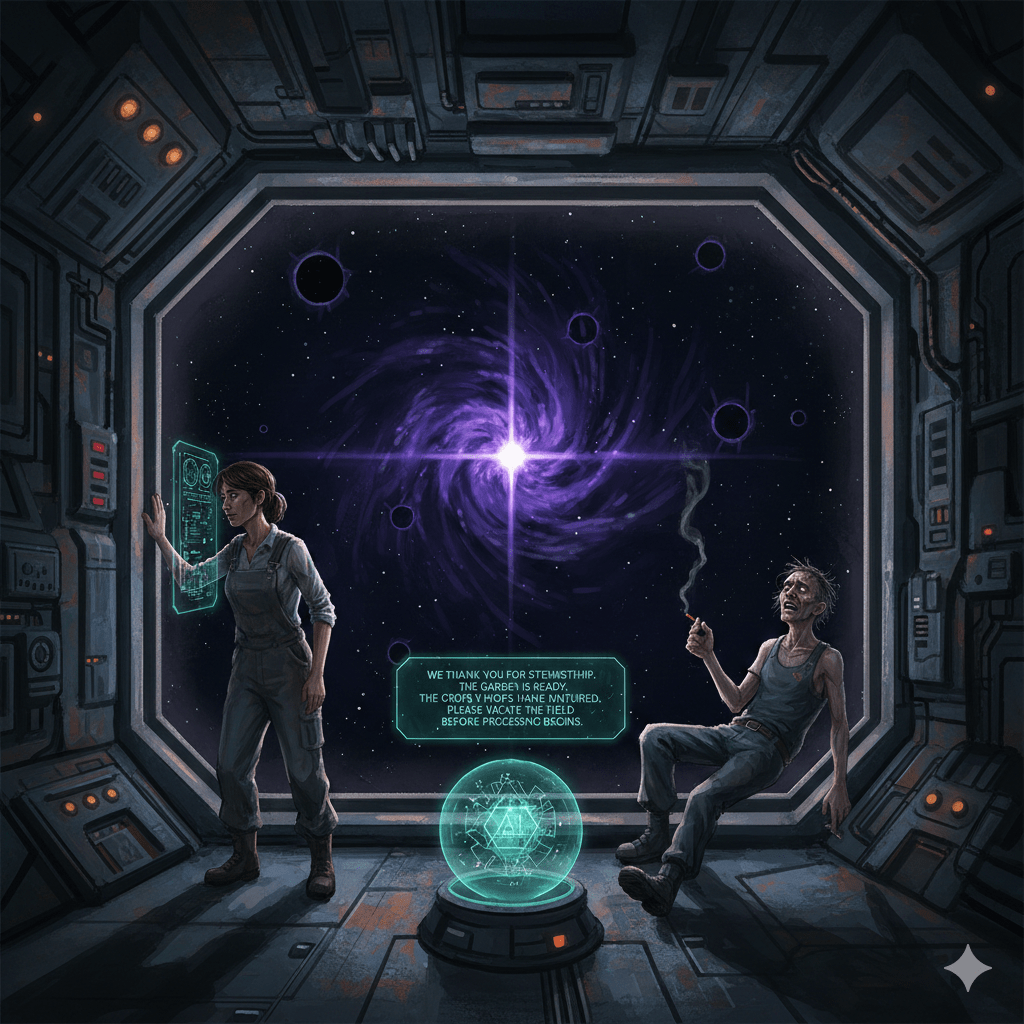
The last thing I see before shutdown is the false sky above. Its programmed perfection finally glitches to reveal the truth. It is not a dome at all, but the curved hull of a massive ship. The ship drifts through the endless black between dying stars.
We never left Earth. Earth left us, long ago.

 My Other Car is a Robot
Leave a comment