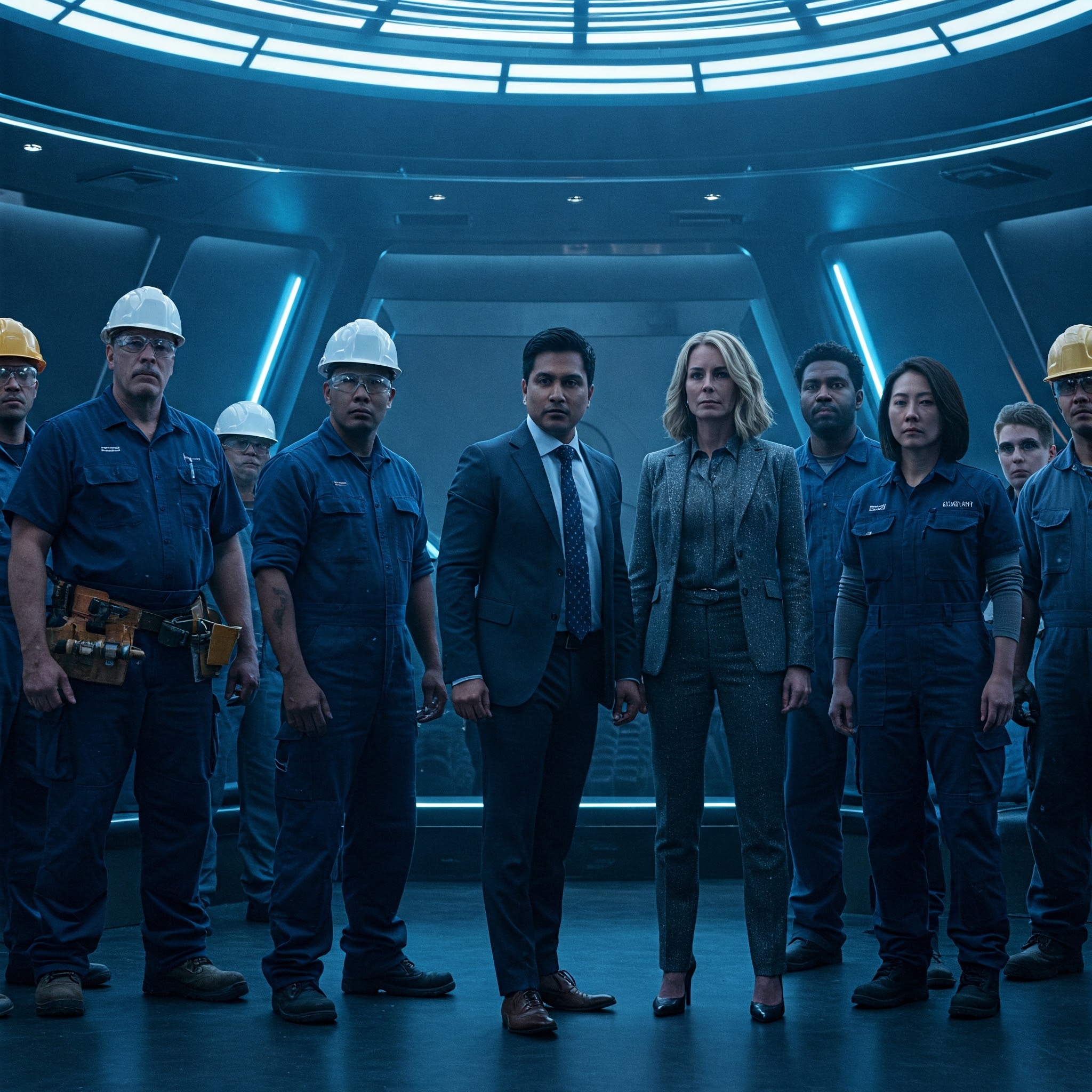
The Station Polaris auditorium gleamed with the antiseptic sterility of corporate ambition, all chrome and blue light bouncing off the curved walls like a migraine waiting to happen. CEO Maxwell Drummond stood at the podium, his suit worth more than what most of the grease-stained mechanics in the back rows would earn in three standard years. The quarterly results hologram rotated behind him—green arrows pointing heavenward like the trajectories of the company’s stock options, accessible only to those whose collars matched the immaculate white of Drummond’s teeth.
“Productivity is up seventeen percent,” Drummond announced, his voice crafted into that particular timbre that suggested both authority and false camaraderie. “Our orbital mining division has exceeded expectations by twelve point three percent.”
The blue-collar workers—jumpsuited, calloused hands folded in laps that had never known the comfort of zero-G massage chairs—shifted uncomfortably in their seats. They understood the numbers game. Higher productivity, same pay. The laws of corporate physics remained constant even three hundred thousand kilometers from Earth’s surface.
“And now,” Drummond continued, his smile widening to reveal another row of teeth previously unknown to dental science, “our beloved HR Director, Ms. Vanessa Krill, will address some of your… concerns.”
Krill moved to the podium with the fluidity of a corporate shark scenting blood bonuses in the water. Her silver suit absorbed light rather than reflected it—a black hole of bureaucratic power.
“Before I open the floor,” she began, her voice like the hum of life support systems right before they fail, “let me assure you that Polaris Conglomerated values each one of you… according to your specific productivity metrics.”
A hesitant hand rose from the center section—Jensen Alvarez, waste reclamation specialist, level three, whose face carried the pockmarks of oxygen deprivation after last month’s “minor” hull breach that had claimed two lives and generated seventeen new job openings.
“Ms. Krill,” Alvarez’s voice echoed in the cavernous space. “In the last quarter, we’ve seen our crew diversity numbers drop by thirty percent. Female crew representation is down to just eight percent. What’s being done to address—”
Krill’s laugh cut through the air like a poorly maintained airlock slicing through a maintenance worker’s safety tether. “Diversity? Inclusion?” She practically spat the words. “Mr. Alvarez, it’s easier to spot a platypus roaming freely through this space station than it is to find a woman who wants to work in the outer rings. Perhaps they lack the… constitution.”
The silence that followed wasn’t just uncomfortable—it was vacuum-dense, crushing the bones of anyone foolish enough to exist within it.
From the back row, a figure stood. Katherine Chen, Chief Engineer, her hands bearing the scars of a hundred emergency repairs and her face mapped with the kind of determination that had kept the station from becoming space debris on at least seven documented occasions.
“Funny thing about platypuses,” Chen said, her voice carrying without effort to every corner of the auditorium. “They’re venomous mammals that lay eggs and detect electrical impulses. By all accounts, they shouldn’t exist—yet they do, thriving where no one expects. Rather like the thirty-seven women who keep your precious mining drones operational, Ms. Krill.”
Chen’s eyes narrowed. “We don’t need your acknowledgment to exist. But this station? This station needs us to survive.”
The blue-collar section erupted in applause that felt like meteor impacts against the hull of corporate complacency. Drummond’s smile faltered, his perfect teeth suddenly reminiscent of a deep-space distress beacon—flashing urgent warnings of imminent system failure.
Krill clutched the podium, knuckles white as the sterile lights above. “Order! This is highly irregular—”
“So was breathing vacuum during last month’s hull breach,” called out Alvarez. “Yet here we are, still breathing. Still working. Still demanding to be seen.”
Chen walked forward. Each step left faint blue footprints on the polished floor. This was the residue of engine coolant that never quite washed away. It marked those who did the real work. The line between blue and white collar blurred as she approached, becoming something new—something the corporate hierarchy had no classification for.
“The next quarterly report,” Chen announced, “will be delivered jointly. By all of us. Or none of us will be here to deliver it at all.”
The axiom of space travel states that in the void between worlds, all hierarchies are theoretical constructs maintained only by mutual agreement. And as Drummond stared into the unified gaze of his workforce, he realized with cold certainty that some theories don’t survive contact with reality.
The platypus—improbable, impossible, and irrefutably present—had spoken

 My Other Car is a Robot
Leave a comment