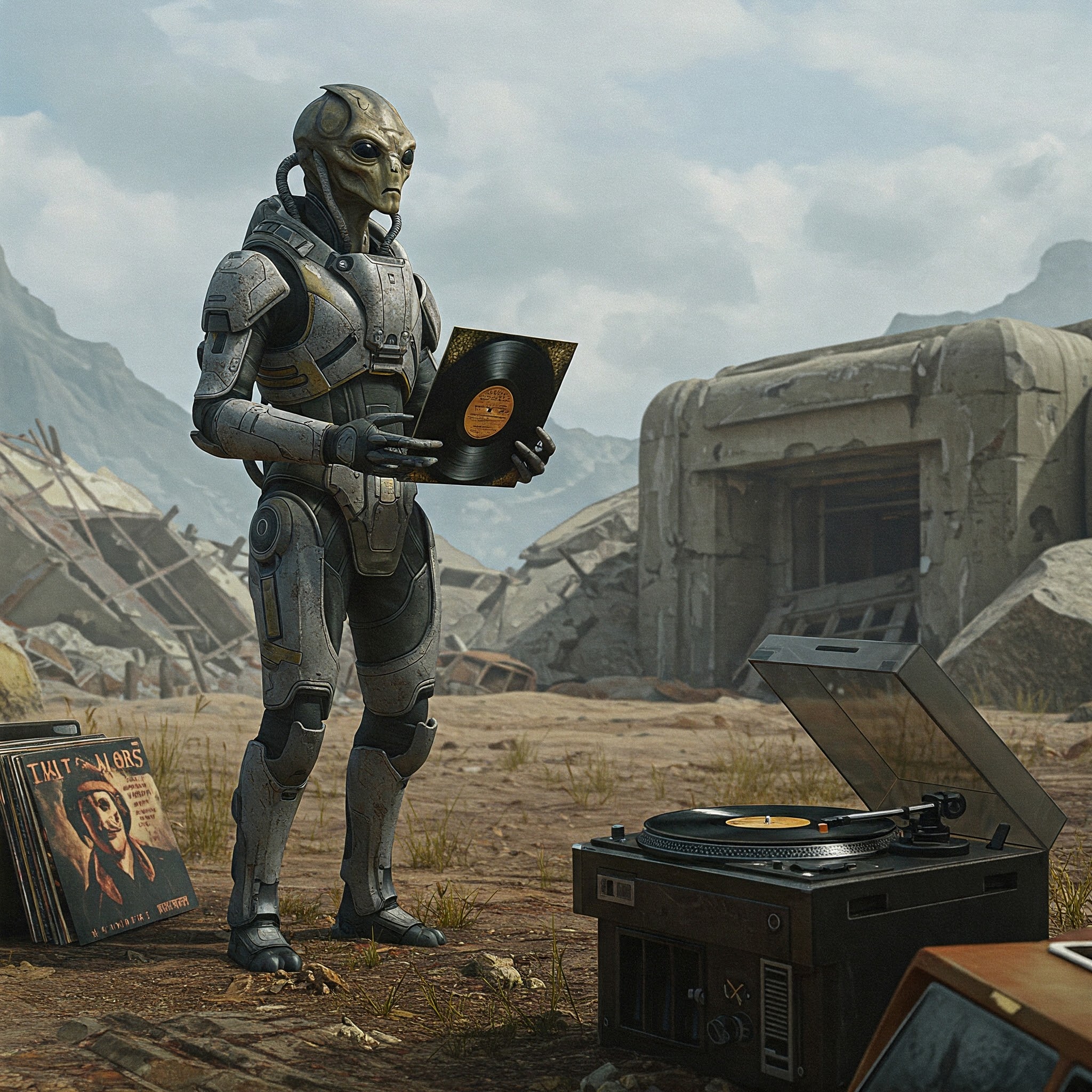
The alien didn’t breathe oxygen. Didn’t need to. But Kha’Vex sucked in something like a breath anyway—an evolutionary remnant, a ghost-reflex from ancestors who once needed such things. The exosuit indicators flashed amber warnings across his tertiary vision field. Toxicity levels beyond operational parameters. The air here was poison, but not the kind that kills quickly.
“This place,” he transmitted, “died the slow way.”
The dead world spread before him like a terminal patient too stubborn to acknowledge the diagnosis. Earth. That’s what they’d called it. Designation XP-3 in the Archival Fleet’s taxonomic system of extinction sites.
No direct reply from Command. Just position coordinates blinking on his neural display. That was fine. He preferred the silence.
Trudging across the brittle landscape, he noted how the ground crunched—not like vegetation, but like billions of microscopic glass needles. Nuclear winter had transformed fertile soil into crystalline death. The Galactic Council had seen it all before. The pattern was the same across seventeen sectors: civilizations reaching critical technology thresholds, then collectively pressing their own extinction buttons.
“Most species,” his instructor had once told him, “invent their way to oblivion.”
The bunker entrance was a wound in the earth’s skin, a technological abscess buried beneath strata of catastrophe. Kha’Vex’s tools made short work of the primitive security systems. The circular door—designed to withstand pressures and temperatures no longer relevant—rolled aside with an obscene metallic groan that echoed through the dead valley.
Inside lay what Command dismissively called “negligible salvage potential.” Bureaucrats with processed minds unable to comprehend value beyond technological advancement metrics.
The chamber beyond the threshold didn’t match expedition projections. No weapons cache. No seed vault. No cryogenic last-chancers.
Just rows of flat, square containers housing black discs. And in the center: a device so primitive it circled back to elegance. A turntable. A vinyl record player, preserved with fanatical attention to detail.
Kha’Vex moved toward it with the reverence his species reserved for extinction event artifacts. His three eyes—superior, central, and peripheral—all focused on different aspects of the collection. Superior eye: structural integrity. Central eye: cultural significance indicators. Peripheral eye: potential toxicity threats.
All clear. All fascinating.
“Command,” he transmitted. “Preliminary assessment: intentional cultural preservation chamber. Request extended survey permissions.”
The reply came without emotion: “Granted. Retrieval protocols secondary to documentation. One rotation maximum.”
One rotation. Twenty-six hours to document what could be the most significant cultural find in his fifteen-cycle career. Idiots. But he’d long ago stopped arguing with the void.
Kha’Vex’s manipulators—evolved for delicacy despite their chitinous structure—extracted the first record from its sleeve. The cover art depicted a human with a lightning bolt slashed across its face. Text overlay: “David Bowie. Aladdin Sane.”
He placed the disc on the turntable, applied power from his exosuit’s auxiliary systems, and lowered the needle. The sound that emerged wasn’t merely sound—it was an abrasion against reality. A voice that sneered and seduced simultaneously, backed by instruments that snarled and whined and pleaded.
The lyrics spoke of catastrophe, of decay, of societal collapse. Prophetic? Or simply the eternal awareness of mortality that haunts all sentient species? Kha’Vex made notes in his field journal, capturing impressions that would be sanitized by Command before reaching the archives.
“These beings,” he wrote, “understood their trajectory. They watched themselves die while still alive.”
Another disc. This one with a stark white cover and the words “Unknown Pleasures” beneath a visual representation of radio pulsar signals. How appropriate, Kha’Vex thought—using the death throes of stars to advertise their own extinction event.
The music erupted like a mental illness—dissonant, hypnotic, laced with despair so profound it transcended species boundaries. The voice sounded like it emerged from a throat already half-closed by death.
This was worth preserving. This was why he’d volunteered for scout duty when his peers chose comfortable administrative positions in the Fleet. Because sometimes, just sometimes, you found the soul of a dead species preserved like an insect in amber.
Seven hours into his survey, Kha’Vex discovered something unexpected. A handwritten journal, tucked between records—a violation of preservation protocols that revealed something the official archives would never contain.
“The bombs are falling,” read the first entry. “Not on us. Not yet. But it’s coming. When the radio stopped broadcasting government assurances, I knew we had days, not weeks.”
The second entry: “Power’s intermittent now. I’ve sealed the bunker. The generator should last long enough to finish what I started.”
The third: “This collection was my life’s work. Three thousand, four hundred and eighteen vinyl records. The pinnacle of human artistic expression. I can’t save my species, but I can save what made us worth saving.”
Kha’Vex set aside his official survey equipment and held the journal with both primary hands. His exosuit’s contamination protocols registered a foreign substance on the pages. Salt water. Tears.
“Command,” he transmitted. “Request archive classification upgrade to Priority Cultural Significance.”
“Negative,” came the reply. “Preliminary scans indicate minimal technological value. Strategic resources undetected. Maintain standard classification.”
Kha’Vex’s morphological features couldn’t form what humans would recognize as a smile, but something within him performed an equivalent function. They always said no. And he always ignored them.
He selected another record. This one contained only numbers as its title: “1999.” The cover depicted figures in purple against a backdrop of apocalyptic symbolism. How fitting, he thought, as he placed it on the turntable.
The music that emerged was unlike the previous selections—a celebration in the face of annihilation. Digitized instrumentation with organic urgency. References to parties at the end of existence. Laughing while the world burned.
Kha’Vex understood then. These weren’t just recordings. They were psychological survival mechanisms. Ways to process the unprocessable.
He documented each record with meticulous care: “Remain in Light” by Talking Heads—paranoia sculpted into rhythm patterns; “London Calling” by The Clash—rage channeled into structured noise; “Rumours” by Fleetwood Mac—interpersonal dissolution mirroring societal collapse; “The Dark Side of the Moon” by Pink Floyd – an exploration of madness and societal breakdown…
In his private notes, he wrote: “They knew. Not just intellectually, but viscerally. They encoded their awareness of extinction into their art. They danced while dying.”
The final record he examined bore none of the ornate packaging of the others. Plain white sleeve, smudged with fingerprints. No text except for a hand-scrawled note: “For whoever finds this—if anyone does.”
The disc itself was not mass-produced but unique—a “lathe cut,” according to his database. A one-off recording. The ultimate rarity.
When the needle dropped, there were no instruments. Just a voice, cracked and tired:
“My name is Dr. Harriet Steel. I am—was—an anthropologist at what was once called MIT. This recording stands as testimony to what we were. The collection surrounding this message represents the pinnacle of human artistic achievement in analog sound reproduction. We could have been more. We chose not to be.”
A pause, filled with nothing but the soft hiss of empty grooves.
“If you’re hearing this, you’re either human—in which case, congratulations on surviving what we couldn’t—or you’re something else entirely. Either way, this is what remains of us. Not our technologies, which destroyed us. Not our philosophies, which failed us. But our music. The way we translated our existence into sound.”
Another pause, longer this time.
“Listen to all of it. Understand us by what we created, not by what we destroyed.”
When his survey time expired, Kha’Vex packed his equipment methodically. Command would expect samples—proof of salvage value. He selected three records at random, knowing they would be disassembled, analyzed for material components, and ultimately discarded as “culturally interesting but strategically irrelevant.”
His final transmission from the surface was brief: “Survey complete. Minimal technological value. Request site preservation for future anthropological study.”
The expected denial came swiftly: “Negative. Site marked for resource extraction. Return to orbit for decontamination and debriefing.”
Kha’Vex acknowledged the order as his pod prepared for ascent. But in his secured personal storage compartment, wrapped in regulation-violating preservation film, rested the plain white record with Dr. Steel’s testimony.
Some artifacts belonged to the universe, not to the archives.
As his pod lifted from the dead world, he felt the weight of the contraband record against his exoskeleton. In seventeen cycles of collecting the remains of extinct civilizations, he had never stolen an artifact. The penalties were severe.
But as Earth receded below him—a mottled sphere of grays and browns where blues and greens had once dominated—he knew with three-eyed certainty that this violation was necessary. Some voices demanded to be heard, even after their species had fallen silent.
In his quarters aboard the Archival Fleet vessel, he would listen to the complete collection from his memory implants. He would write the unauthorized history of a world that killed itself with technology but saved itself through art. And perhaps, when the time came for his final report, he would include the truth that Command never wanted to hear:
That the truly valuable salvage from dead worlds was never the technology that destroyed them, but the beauty they created while dying.

 My Other Car is a Robot
Leave a comment