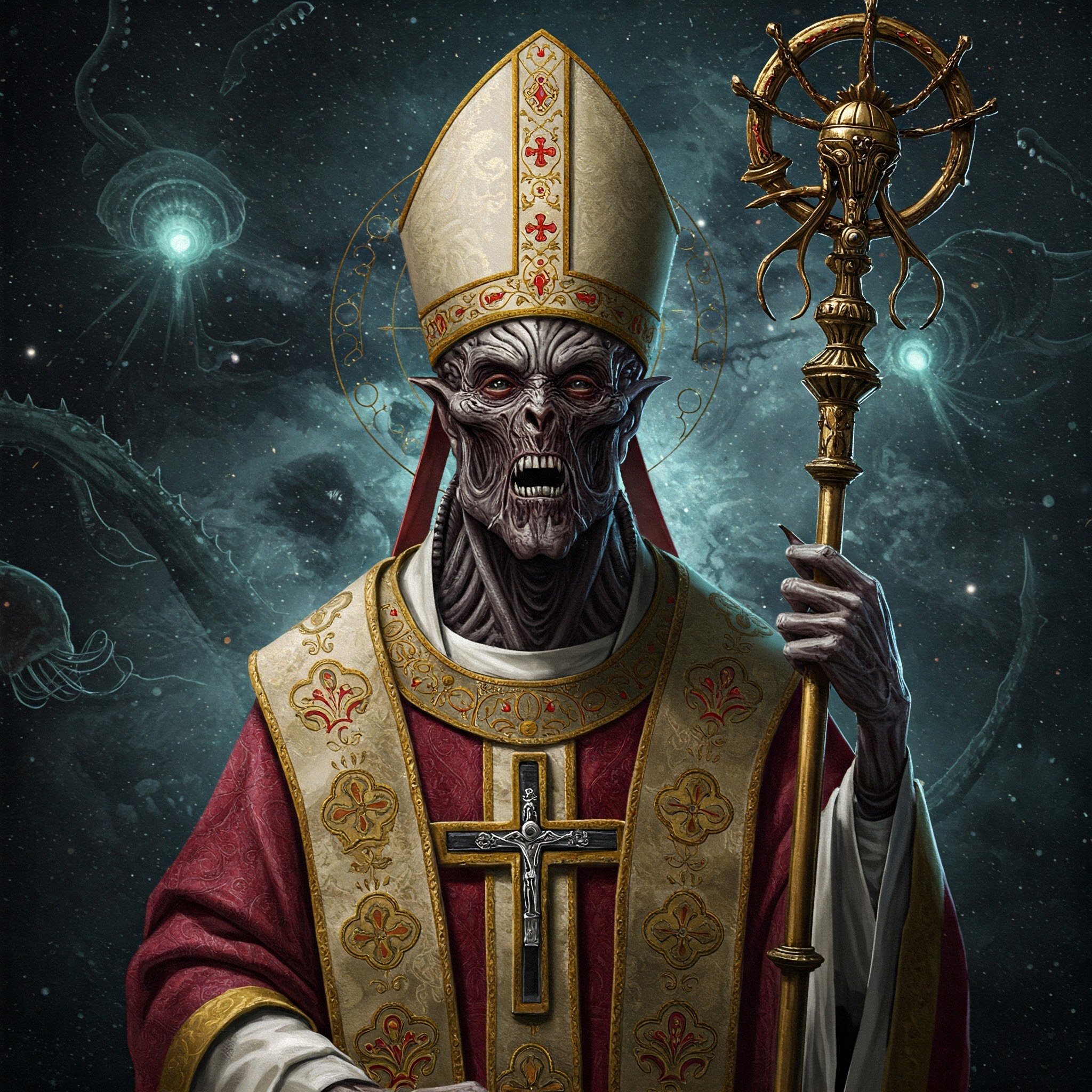
The incense hung thick in the air of the Sistine Chapel, curling tendrils that wrapped around the scarlet-robed cardinals like ethereal serpents. Cardinal Lorenzo Bianchi tried to still the trembling in his hands as he placed his ballot in the chalice. Something was wrong. He had felt it since the moment Cardinal Xentius had arrived from that obscure diocese in South America three years earlier.
“In nomine Patris,” he whispered, completing the ritual. The words felt hollow in his mouth.
The Camerlengo’s voice droned in Latin, calling forth each Cardinal by seniority. One hundred and twenty men of God shuffling forward, dropping their folded ballots into the ancient vessel. One hundred and twenty men about to change the course of human history without knowing it.
Bianchi watched Cardinal Xentius from across the chapel. The man never sweated, despite the stifling Roman summer heat that penetrated even these sacred walls. His pale, almost bluish skin remained dry, his movements precise and economical. Too economical.
“Have you noticed how he never blinks?” Cardinal Rossi had whispered to Bianchi during yesterday’s scrutiny. “Not in unison, anyway. One eye, then the other. Like a… like a reptile.”
Bianchi had dismissed the observation then. Now, as the final votes were tallied, he wasn’t so sure.
“Habemus Papam!”
The announcement crashed against Bianchi’s ears like thunder. The votes had been counted with unprecedented speed. Cardinal Xentius had received one hundred and nineteen votes. Only Bianchi had voted otherwise.
***
The new Pope took the name Celestine VI, though there was nothing celestial about him. Not in the Christian sense, anyway.
Bianchi watched from the shadows of St. Peter’s Basilica as the new Pontiff addressed the throngs in the square below. The white papal robes seemed to shimmer against his unusual skin. Was it a trick of the light, or did scales momentarily ripple beneath the fabric?
“My children,” the Pope’s voice resonated with an unnatural timbre that nonetheless captivated the masses. “I bring you news of great joy. The time of waiting is over. The prophecy fulfilled. The second coming is upon us!”
The crowd erupted in ecstatic cheers, but Bianchi felt only dread coiling in his gut.
That night, alone in his quarters, Bianchi reviewed his notes—observations collected over the three years since Xentius had appeared. The Cardinal’s peculiar eating habits—consuming only certain minerals dissolved in water. His quarters, kept at scorching temperatures. The strange mechanical device he thought he’d glimpsed beneath Xentius’s robes when passing his chambers one night.
A communication device? A weapon?
A knock at his door startled him. He swept the papers into a drawer.
“Enter.”
It was Sister Agnes, the Pope’s new secretary. Her eyes were glazed, vacant.
“His Holiness requests your presence, Cardinal Bianchi. Immediately.”
***
The Pope’s private study was bathed in red light from oddly shaped lamps. Bianchi felt his skin crawl as he knelt to kiss the papal ring. Up close, he could smell something acrid and chemical emanating from Celestine’s skin.
“Rise, my son.” The Pope’s voice had changed, the public charisma replaced by something cold and detached. “You alone did not vote for me. Why?”
Bianchi’s mouth went dry. “The Holy Spirit guides our votes, Your Holiness. I voted as my conscience dictated.”
“Conscience,” the Pope repeated the word as if tasting an unfamiliar cuisine. “Such a peculiar concept. A biological illusion evolved to maintain social cohesion.”
“With respect, Your Holiness, that sounds like heresy.”
The Pope’s laughter was like glass breaking. “Heresy implies an orthodoxy worth preserving. Your species has exhausted its potential, Cardinal. Two thousand years of waiting for a messiah who was never more than a scout for our arrival.”
Bianchi’s blood froze. “Our?”
The Pope’s eyes suddenly shifted, the pupils elongating into vertical slits. “My people have watched your planet for millennia, Cardinal. We seeded the religions that would make you compliant. Jesus of Nazareth was one of our anthropologists, studying human potential. His resurrection was merely a demonstration of our technology.”
Bianchi backed toward the door. “You’re insane.”
“I am the culmination of cosmic design.” The Pope raised his hands, and the skin began to split along invisible seams, revealing a chitinous exoskeleton beneath. “Tomorrow, I will address the world. I will reveal the ‘miracle’ of the Second Coming. And when I do, it will be the signal for our ships to decloak in the skies above every major city.”
Bianchi fumbled for the door handle, but found it locked.
“You cannot leave, Cardinal. Not now that you know. But take comfort—your species will not be exterminated. Merely… guided. The meek shall inherit the Earth, as your book says. But the stars? The stars belong to us.”
The thing that had been Cardinal Xentius, now Pope Celestine VI, extended a limb that was no longer remotely human. From somewhere beyond the walls of the Vatican, Bianchi heard a low, resonant hum beginning to build.
“The Rapture comes, Cardinal. Though not quite as your theologians imagined it.”
***
Dawn broke over Rome, the eternal city that had survived countless invasions throughout its storied history. As the sun crested the horizon, Pope Celestine VI emerged onto the balcony overlooking a packed St. Peter’s Square. Millions more watched via satellite broadcast.
Cardinal Bianchi stood behind him, his face a mask of forced serenity hiding the horror within. The Pope had shown him the truth during that long night—visions of an interstellar empire spanning galaxies, of worlds subjugated and transformed, of humanity’s place in a cosmic hierarchy that had nothing to do with divine will and everything to do with calculated exploitation.
“My children,” the Pope began, his voice carrying to every corner of the square. “Today marks the fulfillment of ancient prophecy. Today, we witness the glory of the Second Coming!”
He raised his hands to the heavens, and as if on cue, the sky darkened. Not with clouds, but with the presence of something vast blotting out the sun.
The crowd’s murmurs turned to gasps, then screams, as massive ships materialized overhead, their hulls rippling with impossible geometries. Smaller craft began to descend toward the Vatican.
And as panic spread through the masses, as governments worldwide scrambled to respond to identical appearances over their territories, Cardinal Bianchi made his choice. He lunged forward, seizing the papal cross—the ferula—from its stand, and with strength born of desperation, drove its pointed base into the back of the false Pope.
The being that had masqueraded as Celestine VI let out an inhuman shriek. Its flesh tore open, revealing the alien form beneath. Ichor sprayed across the white marble as Bianchi twisted the cross deeper.
On live television, before the eyes of billions, humanity witnessed the death of a creature that should not exist.
But it was too late. The signal had been sent. Above, the invasion ships deployed their first wave.
Bianchi slumped to his knees beside the twitching alien corpse, the papal cross still clutched in his bloodied hands.
“May God forgive us,” he whispered, “for believing we were alone.”
The Second Coming had arrived. Not with salvation, but with conquest. Not with trumpets, but with the thunder of alien engines. Not with Christ, but with something ancient and hungry that had waited patiently in the dark between stars.
And humanity would never again look at the heavens with the same eyes.

 My Other Car is a Robot
Leave a comment