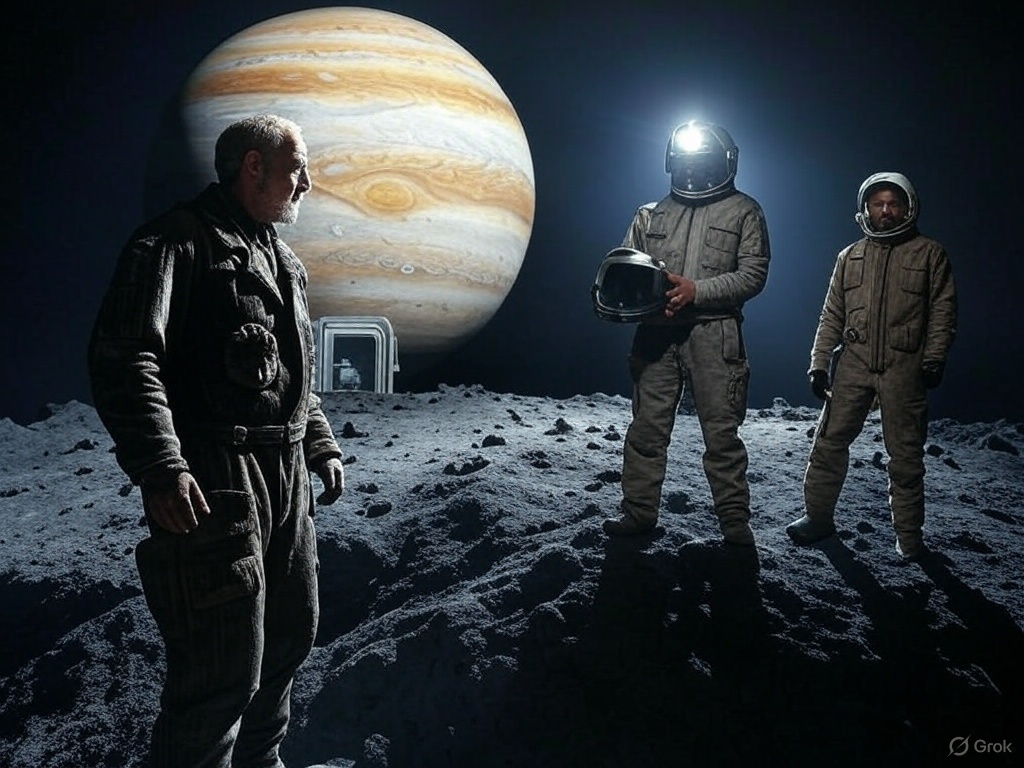
The alarm blared exactly four minutes after Marlowe settled into his first REM cycle of the night. That was how these things always worked. The universe—or whatever higher intelligence dictated the cruel machinery of existence—had a perverse sense of timing.
“Proximity alert, sector five. Unidentified subjects. Proximity alert.”
Marlowe’s eyes snapped open into darkness. His habitat module, carved from the nickel-iron heart of asteroid 4738 Minos, vibrated slightly with the alarm’s insistence. He fumbled for the bedside panel, fingers sliding across cold metal until they found the glowing interface.
“Visual,” he croaked. The wall opposite his sleep pod flickered to life, revealing the exterior feed.
Two figures in unmarked pressure suits moved across the regolith surface of his asteroid, their helmet lamps swinging erratically across the jagged landscape. They carried what appeared to be sample collection equipment, methodically taking core samples from Marlowe’s home.
“What the fuck?” he muttered.
Marlowe had lived in the Belt for fifteen years, establishing his claim on Minos through the New Frontier Colonial Initiative. Like most Belt homesteaders, he’d left Earth when the megacorporations had begun their aggressive resource acquisition programs. The Belt represented freedom, independence, a place where a person could actually own something outright.
And now strangers were walking across his goddamn property.
“Taryn,” he called out. “Wake up.”
His wife’s voice replied from the adjacent pod, groggy with interrupted sleep. “What is it? Raiders?”
“Not raiders. Something else. Suits look too clean.”
Marlowe pulled himself from bed, the microgravity making the motion more graceful than his middle-aged body deserved. He reached for his own pressure suit hanging on the wall—a patchwork affair of salvaged components and homespun repairs.
“Wake Dylan,” he told Taryn. “I’m going out.”
Fifteen minutes later, Marlowe cycled through the airlock, magnetic boots adhering to the metallic surface of the asteroid as he emerged into the eternal night. The cosmos surrounded him—that familiar vertigo-inducing infinity that never quite became routine, no matter how many years you spent in the void. Jupiter loomed massive in the distance, a baleful eye watching the scattered children of the Belt.
Marlowe’s teenage son, Dylan, followed him out, suited up and carrying the pulse rifle they kept for emergencies. The strangers had moved to the far side of their habitat module, where Marlowe’s hydroponic garden extended in a transparent dome.
“Who the hell are they?” Dylan’s voice crackled through the comm.
“We’re about to find out.” Marlowe toggled his external speaker. “This is private property! Identify yourselves immediately!”
The two figures stopped their activities and turned slowly. Their suits bore no corporate insignia, no national flags, nothing to identify their affiliation. The taller of the two raised a hand in what might have been greeting or might have been dismissal.
“Private property?” The voice that came through Marlowe’s receiver was female, cultured, with an accent he couldn’t immediately place. “Interesting interpretation of territorial rights.”
“There’s nothing to interpret,” Marlowe snapped. “This asteroid is registered under the NFCI. My family has lived here for eight years. We have documentation.”
The second figure approached, movements casual, unthreatening. “Ah, yes. The New Frontier Colonial Initiative. American, I presume?”
“What difference does that make?” Dylan cut in, adjusting his grip on the pulse rifle.
The two strangers looked at each other, a private communication passing between them. The taller one reached up and, to Marlowe’s shock, unsealed her helmet. In the vacuum of space, she lifted it off entirely.
Instead of the explosive decompression he expected, Marlowe saw a woman’s face, middle-aged, sharp-featured, with close-cropped silver hair. She smiled, and her voice came through clear as day without the aid of communication equipment.
“It makes every difference, I’m afraid. My name is Dr. Eleanor Whitfield, Royal Astronomical Survey. This is my colleague, Dr. Mbeki.”
The second figure removed his helmet as well, revealing a dark-skinned man with a neatly trimmed beard.
Marlowe stared in disbelief. “How are you—”
“Breathing?” Dr. Whitfield smiled wider. “Respiratory nanotech. Standard issue for the Survey these days. Much more efficient than these cumbersome suits, but protocol insists we wear them anyway.”
Marlowe felt the familiar disorientation that came with encountering Earth technology decades ahead of what filtered out to the Belt. The inequality of it stung like a physical blow.
“You still haven’t explained what you’re doing on my asteroid,” he said.
Dr. Whitfield’s expression shifted to one of polite confusion. “Your asteroid? I believe there’s been a misunderstanding. We’re simply exercising our right to roam.”
“Your what?”
“Right to roam,” Dr. Mbeki said, speaking for the first time. His accent was distinctly South African. “An ancient principle of British common law, codified in the Historic Rights Act of 2156 and extended to extraterrestrial holdings under the Crown Space Mandate of 2256.”
Marlowe blinked inside his helmet. “Crown… what? This is Belt territory. There are no countries out here.”
Dr. Whitfield produced a small device that projected a holographic document between them. “Actually, the entirety of the asteroid belt was claimed by the British Crown in 2256, nearly forty years ago. Didn’t your colonial registry mention this?”
Dylan stepped forward, rifle still raised. “That’s impossible. The Belt is free territory. It’s why we came here!”
“A common misconception,” Dr. Whitfield said, nodding sympathetically. “The Americans led many to believe their homesteading initiative provided sovereign rights, but I’m afraid they were settling on Crown territory all along. The Crown has simply been… hands-off in its administration.”
Marlowe felt a cold that had nothing to do with the vacuum of space. “So what does that mean for us?”
“Oh, nothing changes regarding your residence,” Dr. Whitfield assured him. “The Crown recognizes your dwelling rights. But under the ancient right to roam, British citizens—and those of Commonwealth nations—maintain the right to traverse open land, collect scientific samples, and engage in non-destructive research.”
“This is my home,” Marlowe said, his voice tight.
“Indeed. Your home, yes. But not, strictly speaking, your land.” Dr. Whitfield smiled again, revealing teeth too perfect to be natural. “Think of it as living in a very exclusive national park. We’ll try not to disturb you further.”
Later that night, after the Royal Astronomical Survey scientists had departed with their samples, promising to return “periodically” for “ongoing assessment,” Marlowe sat in the habitat’s small common room with Taryn and Dylan.
“Can they really do this?” Taryn asked, her face drawn with worry.
Marlowe stared at the document the scientists had transmitted to their system—a complex legal text detailing the Right to Roam the Void Act, authorized by a Parliament he had never acknowledged, enforced by a Crown he had fled Earth to escape.
“I don’t know,” he admitted. “But I’m going to find out.”
Dylan paced the small space, his youthful outrage palpable. “This is theft. They’re stealing our independence. First it’s ‘scientific samples,’ then what? Taxes? Conscription?”
“They mentioned others,” Taryn said quietly. “Other homesteaders. We should contact them.”
Marlowe nodded slowly, his mind racing ahead. The Belt contained thousands of independent homesteaders like themselves—people who had sought freedom from Earth’s consolidated power. If what the surveyors claimed was true, none of them truly owned what they had built.
But there was something else bothering him, something about the way Dr. Whitfield had removed her helmet with such casual disregard for the vacuum of space. The nanotech she mentioned—that level of advancement meant Earth had diverged from Belt technology far more than anyone realized.
“I think,” Marlowe said carefully, “we might have been living in an illusion all along.”
Taryn looked at him sharply. “What do you mean?”
“Freedom, ownership, independence—maybe those were just stories we told ourselves while the powers back on Earth were making other plans.” He gestured at the document glowing on their screen. “Maybe reality itself has been redefined without our consent.”
Dylan stopped pacing. “So we fight back, right? Contact the other homesteaders, form an alliance?”
Marlowe thought of those helmets coming off in vacuum, of the casual power demonstrated in that simple act. He remembered the strange look in Dr. Whitfield’s eyes—a look that seemed to see through the illusion of human autonomy itself.
“I think,” he said slowly, “we need to find out what they’re really looking for in those samples first. Because I don’t believe for a second this is about some ancient right to roam.”
Outside their habitat, the stars continued their cold, distant observation of humanity’s spreading influence. Somewhere among them, Dr. Whitfield was already examining the core samples taken from Marlowe’s asteroid—samples that might reveal the true nature of reality itself, and humanity’s place within it.
And in the darkness of the Belt, other surveyors were knocking on other doors, quoting ancient laws to justify their intrusions into carefully constructed lives—lives that might have been built on foundations as insubstantial as solar wind.

 My Other Car is a Robot
Leave a comment