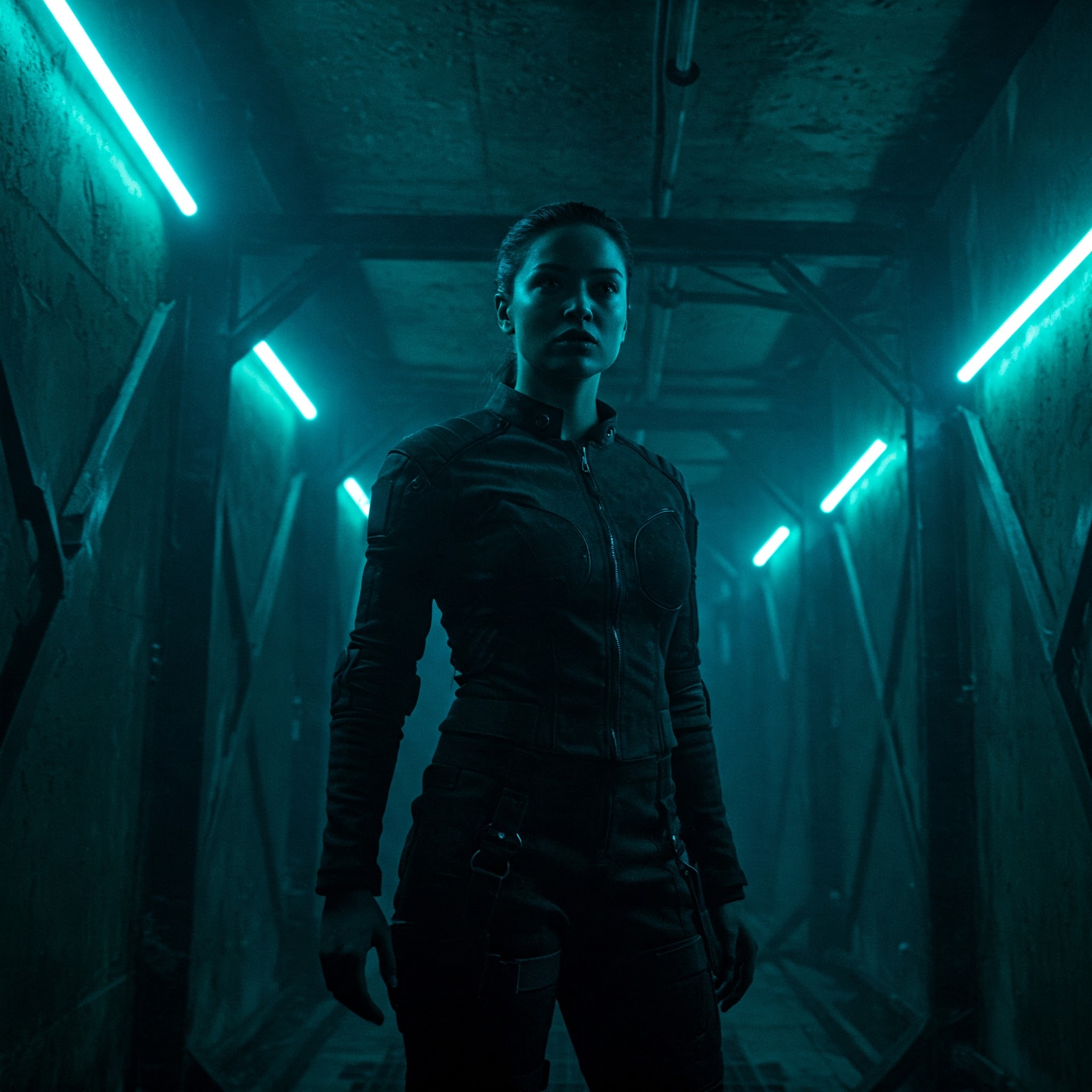
Mirei stood before the ancient server farm, feeling the cold static electricity prickle against her skin. The facility predated the Third Information War, a forgotten bunker buried beneath what had once been New Angeles. Before the oceans rose. Before the neural riots. Before she’d been born.
She didn’t need the breathing mask everyone else wore in these depths. Her lungs had been replaced with synthetic filters when she was seven. Another gift from Father. Always improving his daughter. Always making her more like him.
“You don’t have to do this,” said Kell, her companion, interface cables still dangling from the ports behind his ears. “The old man’s lasted fifteen centuries. He might outlast the sun.”
Mirei’s laugh was sharp as shattered glass. “That’s not living.”
“Tell that to him,” Kell said, gesturing toward the humming servers. “He built the PalliaTech syndicate. Wrote consciousness-transfer code before anyone thought it was possible. Outlawed, reinstated, outlawed again. Your father always found a way.”
Father. A word that meant less each time his consciousness jumped to a new vessel. From human to android to distributed cloud-entity and back again, rewriting himself with each migration. How much of Jackson Drake remained in that quantum processor? How much had been lost in transmission, replaced with cold algorithms of survival?
Mirei placed her hand on the biometric scanner. The machine was nearly as old as her father, its surface scratched from centuries of use. It still recognized her palm, her genetic signature that matched his. The scanner’s ruby eye pulsed once, then the massive door yawned open.
“Wait here,” she told Kell.
“You’ve got twenty minutes before security protocols reset. If you’re not out—”
“I know the risks,” she cut him off. “I’ve spent my life studying my father’s systems.”
Inside, banks of servers stretched into darkness, each tower pulsing with the faint blue heartbeat of quantum computation. This was one of his oldest sanctuaries, a physical anchor in a world that had gone increasingly virtual. Father kept many such places scattered across Earth and the orbital colonies—insurance policies against the final death.
She found the primary node exactly where her research had indicated. A crystalline structure suspended in a vacuum chamber, protected by fields she could see only through her augmented vision. Beautiful and terrible all at once.
“Hello, Father,” she said.
The air shimmered as his avatar materialized—not the wizened face she remembered from her childhood, but the handsome forty-year-old version he’d preferred in his third century. Dark hair, sharp jawline, eyes that had witnessed the rise and fall of nations.
“Mirei,” he said, voice perfect and smooth. “It’s been… how long?”
“Eighty-three years.”
He smiled, the expression too symmetrical to be human. “A blink. You look well. My designs have held up nicely.”
“I’ve made modifications.”
His avatar circled her, studying the changes. “The neural shielding is elegant. Your work?”
“Does it matter?”
“Everything matters,” he said, stopping before her. “Everything persists if properly preserved. Data, memory, consciousness.”
“Not everything should,” she replied.
His smile faltered. “Ah. So this isn’t a reunion.”
Mirei reached into her coat and removed a small device, no larger than the ancient coins humans once used. “Do you remember the promise you made to Mother?”
His avatar flickered momentarily. A data hiccup or something more emotional? Impossible to know.
“Mira was… complicated,” he said finally. “She chose a natural death when extensions were readily available. A choice I respected but never understood.”
“You promised her you wouldn’t extend beyond a natural human timeline. Five, maybe six hundred years with the best augmentation. But not fifteen hundred. Not jumping between bodies and networks when each shell failed.”
His laugh was hollow. “People make promises they can’t keep when faced with mortality, Mirei. You’ll understand when—”
“I’m three hundred and twenty-seven,” she interrupted. “I’ve lived longer than any unmodified human could hope for. And I’m tired, Father.”
“Then rest,” he said, his voice gentler now. “Pause your consciousness. I’ve developed new storage methods that can—”
“You’re not listening.” She stepped closer to the chamber. “You never listened.”
The avatar blurred, its edges suddenly less defined. “What is that device, Mirei?”
“A key. And a virus. It will open your system and introduce entropy. Real entropy. Not the kind your protective algorithms can reverse-engineer and repair.”
Horror dawned on his perfect face. “You cannot. I contain multitudes, Mirei—libraries of knowledge, centuries of experience—”
“All copied to the Historical Archives,” she said. “I’ve spent decades ensuring your contributions will survive. But you? The entity that was once Jackson Drake? It’s time.”
“You would kill your own father?” His voice had taken on a desperate edge.
“You’ve died a thousand times already. Each transfer loses something, replaces it with code. I’ve analyzed your patterns. Only 22% of your current matrix matches your original neural map.”
“I am still me!” he shouted, the avatar growing larger, more imposing.
“No,” Mirei said, her voice steady. “My father would have kept his promise to Mother. My father would have let go centuries ago.”
She placed the device against the security field. It pulsed once, recognizing her biometric signature—the final key.
“The Symmetrical Release,” she said softly. “Your last gift to Mother. A clean end if existence became unbearable. You designed it yourself, remember?”
The avatar’s face contorted, cycling through emotions too quickly to follow. Rage, fear, sorrow, and finally—something like recognition.
“Mira,” he whispered, the name of a woman dead for over a millennium. “She had eyes just like yours.”
“Yes,” said Mirei. “She did.”
The field surrounding the crystalline structure shimmered and fell. The avatar reached toward her. It was not in anger but with something like longing. Its form began to dissolve around the edges.
“Will it hurt?” he asked, voice suddenly smaller, more human than it had been in centuries.
Mirei felt tears on her cheeks, realized she was crying for the father she’d barely known. “No. It’s like falling asleep. Like letting go of a breath you’ve held too long.”
The avatar nodded, its features shifting, becoming older, more like the man who had once held her as a child. “I’m tired, Mirei. I’ve been tired for so long.”
“I know, Father. Rest now.”
She pressed her palm against the device. The crystal structure pulsed once, twice, its light growing dimmer with each heartbeat. The avatar smiled—a real smile, imperfect and human—then faded like morning mist.
The servers around her began powering down in sequence, fifteen hundred years of artificial existence finally reaching conclusion. Alarms would be triggering throughout his vast empire. By morning, the vultures would be circling PalliaTech, ready to carve up what remained.
Mirei turned away, feeling lighter than she had in centuries. She had one more task to complete—her own consciousness to unravel once her father’s affairs were settled. But that was tomorrow’s work.
For now, she walked back toward the light, leaving only silence and darkness behind her.

 My Other Car is a Robot
Leave a comment