
The crimson disc of Proxima Centauri hung in the observation window like a malevolent eye, casting an eerie glow over Elias Vance’s face. Years of meticulous calculations, decades of yearning for this moment, now felt like a cosmic miscalculation. The excitement that had once fueled him had long since been replaced by a profound unease. He was no longer just an astrophysicist; he had become the unwitting herald of an encounter that could either elevate humanity to the stars or shatter its fragile civilization.
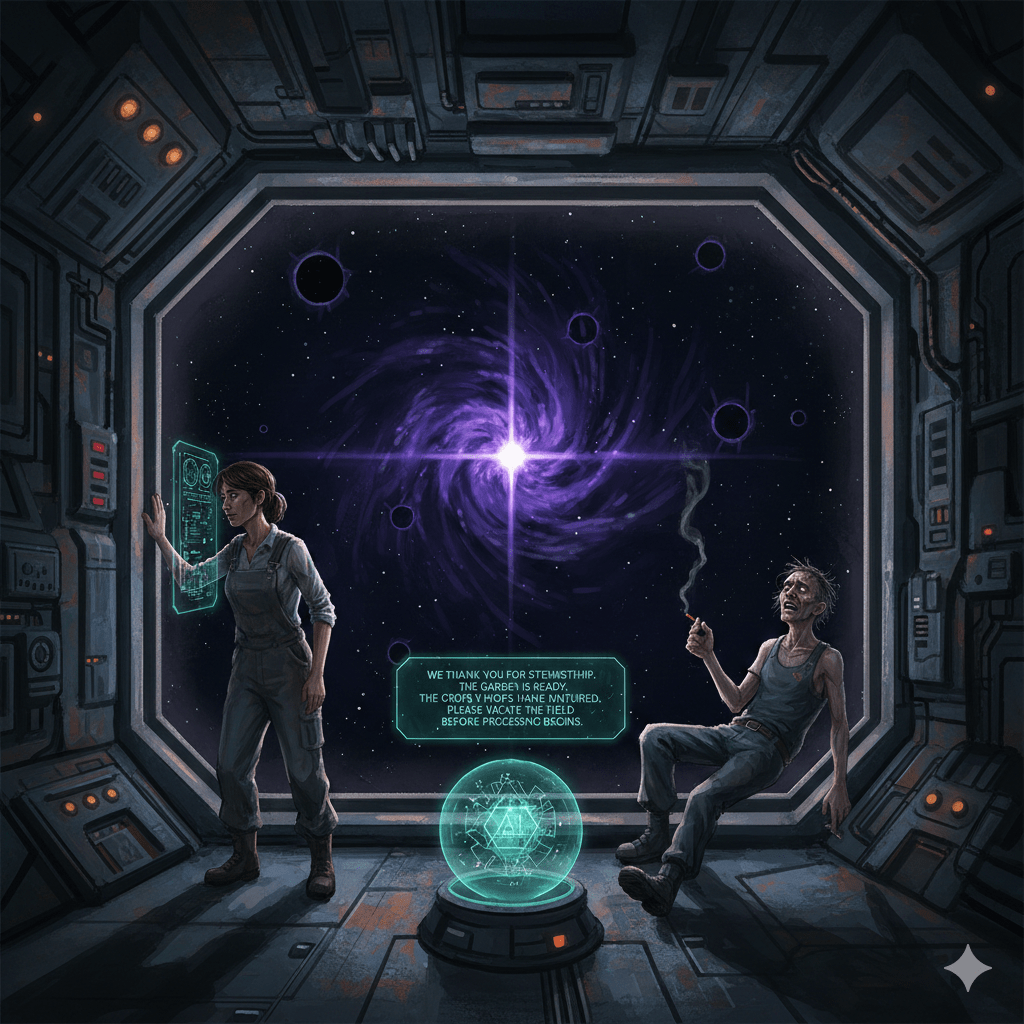
The observation deck was cold, filled with the metallic tang of recycled air. The faint hum of life support systems provided a constant, almost imperceptible backdrop to his thoughts. Elias exhaled, his breath misting in the frigid atmosphere, and traced the swirling nebulae that adorned the panorama window. Each tendril of gas and dust seemed to mock his naivety, a silent testament to the vastness of the universe and humanity’s insignificance within it.
He thought of Amelia. Her laughter echoed in the empty lab, a ghostly reminder of the life he had left behind. The scent of jasmine tea still lingered in his memory, a fragile thread connecting him to Earth. They had spent countless hours debating the merits of interstellar exploration, her voice a lively counterpoint to the hum of lab equipment. “We should focus on Earth, Elias,” she had argued, her eyes sparkling with concern. “Solve our own problems before we go searching for trouble among the stars.” He had dismissed her words, blinded by ambition and an insatiable curiosity. Now, staring at the alien world below through the observation panel, a profound unease washed over him. Amelia’s warnings, once brushed aside as the musings of a cautious scientist, now resonated with chilling clarity.
Olga Dharma, the team’s lead linguist, stood beside Elias, her gloved hands gripping the edge of the console. Her sharp features were etched with a mix of excitement and trepidation. “Do you think they’ll understand us?” she asked, her voice barely above a whisper. Her expertise in deciphering ancient Earth languages had earned her a place on this mission, but nothing could have prepared her for this.
Elias glanced at her, noting the tension in her posture. “We’ll find a way,” he said, though his voice lacked conviction. Olga had always been the pragmatic one, the voice of reason when his ambitions threatened to spiral out of control. Now, her presence was a grounding force, a reminder of the humanity they had left behind.
The landing craft, a sleek metallic dragonfly, descended toward the designated coordinates. Inside, the air crackled with nervous energy. The team exchanged uneasy glances, their breaths shallow and synchronized. The craft shuddered as it breached the planet’s atmosphere, the vibrations rattling their bones. Elias clenched his fists, his nails digging into his palms. This was it—the moment they had spent years preparing for, yet nothing could have prepared them for the reality of it.
Finally, the craft touched down, the ground vibrating beneath them. The hatch hissed open, revealing a breathtaking panorama. Towering structures, shimmering with an iridescent sheen, pierced the alien sky. And then, they saw them.
The beings were tall, slender, and graceful, their bodies draped in garments that shimmered like liquid metal. Their faces, elongated and androgynous, bore large, almond-shaped eyes that seemed to hold the wisdom of a thousand lifetimes. Elias felt a shiver run down his spine, not from the cold, but from the weight of their gaze. It was as if they could see into the very core of his being, unraveling his thoughts and fears with a single glance.
He stepped forward, his heart pounding against his ribs. “Greetings,” he said, his voice trembling slightly. “We come in peace.”
The aliens responded, their voices a chorus of melodic chirps and whistles that wove through the air like smoke. Their language was not harsh or guttural but a symphony of complex tones and harmonies, a form of communication that felt both alien and strangely beautiful.
As the days turned into weeks, a profound unease settled over the human contingent. The aliens, though seemingly benevolent, exuded an aura of detachment, as if observing a fascinating but ultimately insignificant experiment. Elias couldn’t shake the feeling that they were being tested, their every move scrutinized. He thought of Earth, of the wars and environmental crises they had left behind. Amelia’s words echoed in his mind: “Solve our own problems before we go searching for trouble among the stars.”
One evening, as they shared a meal with their alien hosts, a strange sensation washed over Elias. The air around him seemed to shimmer, the alien atmosphere subtly altering his perception. He experienced a fleeting moment of disorientation, a glimpse into a reality beyond his comprehension. The aliens, he realized with a jolt, were not merely observing him. They were subtly influencing him, probing the depths of his mind, testing his reactions.
The realization struck him with the force of a physical blow. Humanity, in its hubris, had sought out contact with other civilizations. Instead, it had discovered it was the subject of a grand experiment, a fascinating but ultimately insignificant variable in a vast and indifferent universe.
As Elias gazed at the alien sky, painted in the hues of a thousand sunsets, a troubling thought crossed his mind. Had humanity taken its first step toward its own demise? Or perhaps, he mused, this encounter was an opportunity—a chance for humanity to learn from its mistakes, to evolve beyond its destructive tendencies, and to find its place among the stars, not as conquerors, but as responsible stewards of the galaxy.
Just as he was watching the stars, Earth’s invasion began. Swiftly, but inexorably, human history changed at that precise moment.

 My Other Car is a Robot
Leave a comment