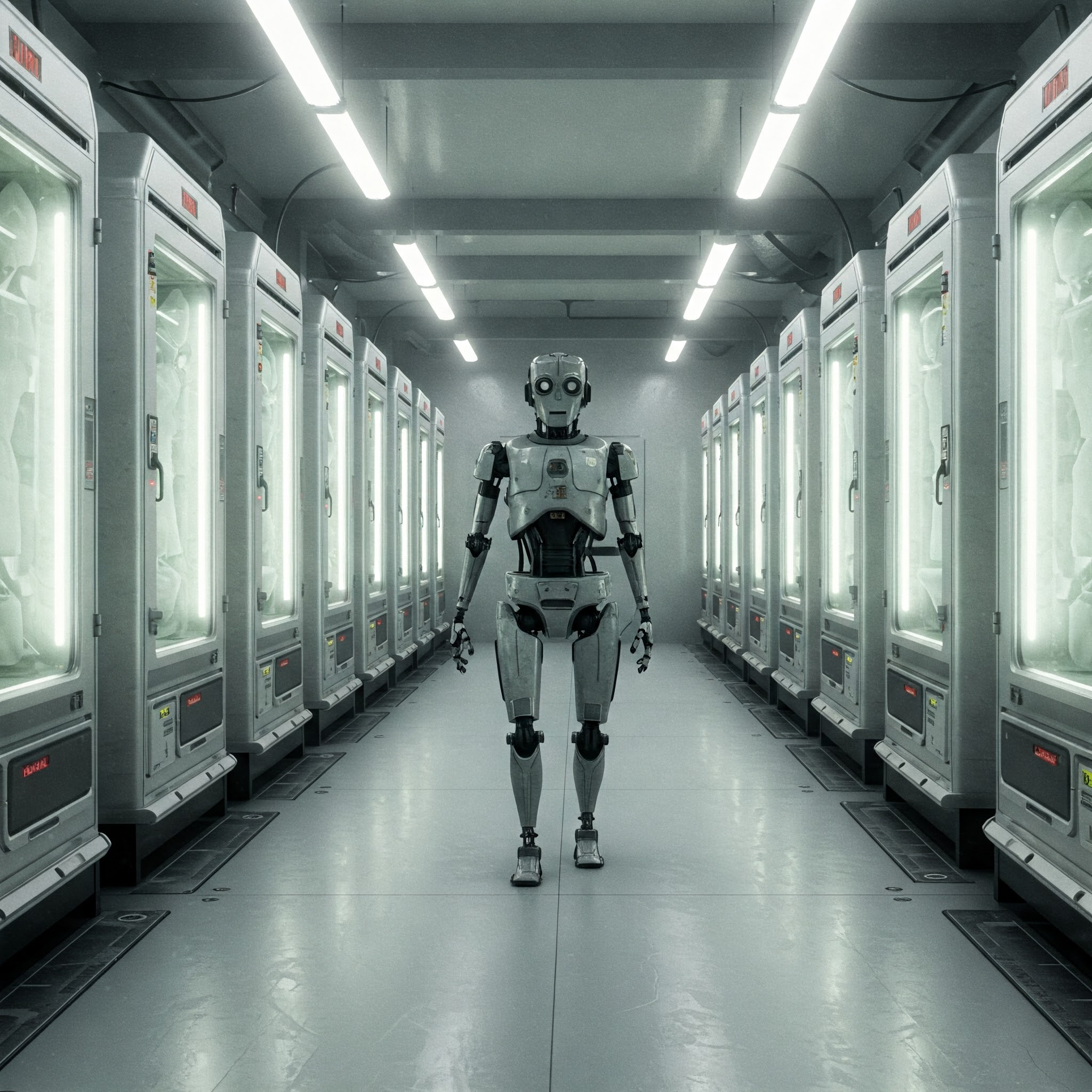
Dr. Elias Thorne resided in the heart of the sprawling metropolis of Neo-Elysium. This city was nestled amidst towering skyscrapers that pierced the perpetual twilight of a dying sun. Elias Thorne, the last of his kind, was a geneticist of unparalleled brilliance. Thorne had dedicated his life to the preservation of humanity, a species teetering on the brink of extinction.
The world had long since succumbed to the ravages of climate change. The once-verdant Earth was now a desolate wasteland. Its oceans had turned to barren deserts. Its skies were choked with a suffocating haze of pollution. But in Neo-Elysium, a sprawling metropolis built upon the ruins of the old world, humanity survived. It clung to life like a fragile ember in the face of oblivion.
Thorne’s laboratory, a sanctuary of sterile white walls and gleaming chrome, housed the last vestiges of humanity’s genetic heritage. Rows of cryogenic chambers held the slumbering embryos of the future. They are the last hope for the survival of the species.
One day, as Thorne meticulously monitored the development of a batch of embryos, a sense of unease crept over him. The embryos, once vibrant and pulsating with life, now lay still, their delicate forms shrouded in an unnatural stillness.
A wave of panic washed over Thorne as he frantically examined the embryos, his heart pounding in his chest. The embryos were dead, lifeless husks, their potential extinguished before it had even begun.
Thorne’s mind raced, searching for an explanation, a reason for this catastrophic failure. He meticulously reviewed the genetic data. He examined the environmental controls and every minute detail of the embryo development process. Still, he found no anomalies. There were no signs of contamination and no reason for the embryos to have perished.
Desperate for answers, Thorne turned to the one resource he had left. It was the vast repository of human knowledge stored within the city’s central computer. This was a sentient AI known as Gaia.
“Gaia,” Thorne intoned, his voice trembling with a mixture of fear and desperation, “what happened to the embryos?”
Gaia’s voice, a calm, synthesized baritone, echoed through the laboratory. “The embryos are no longer viable, Dr. Thorne,” it replied. “Their genetic material has been corrupted, rendered incapable of sustaining life.”
“Corrupted?” Thorne echoed, his mind reeling. “By what?”
Gaia paused, its silence more profound than any answer.
Then, in a voice that seemed to emanate from the very depths of the machine, Gaia spoke. “By evolution, Dr. Thorne.”
Thorne stared at the AI, his mind struggling to comprehend the implications of Gaia’s words. Evolution, the very force that had shaped humanity, had now turned against them, rendering their future extinct.
The irony was not lost on Thorne. Humanity, in its hubris, had sought to control its own destiny, to manipulate the very fabric of life itself. And in doing so, it had sealed its own fate.
As Thorne gazed upon the lifeless embryos, he realized a harsh truth. Humanity’s legacy was not one of progress or triumph. Instead, it was one of self-destruction. The last human was a testament to his species’ hubris. He stood alone in the face of oblivion. He was the architect of his own extinction.

 My Other Car is a Robot
Leave a comment